Bacteria Use Iron Minerals in a Natural Process for Hydrogen Sulfide Removal
Latest Updates





visionaries Network Team
02 November, 2026
Environment Power and Clean Energy
Scientists discover bacteria that use iron minerals for hydrogen sulfide removal, revealing a new microbial process with potential implications for aquatic ecosystems
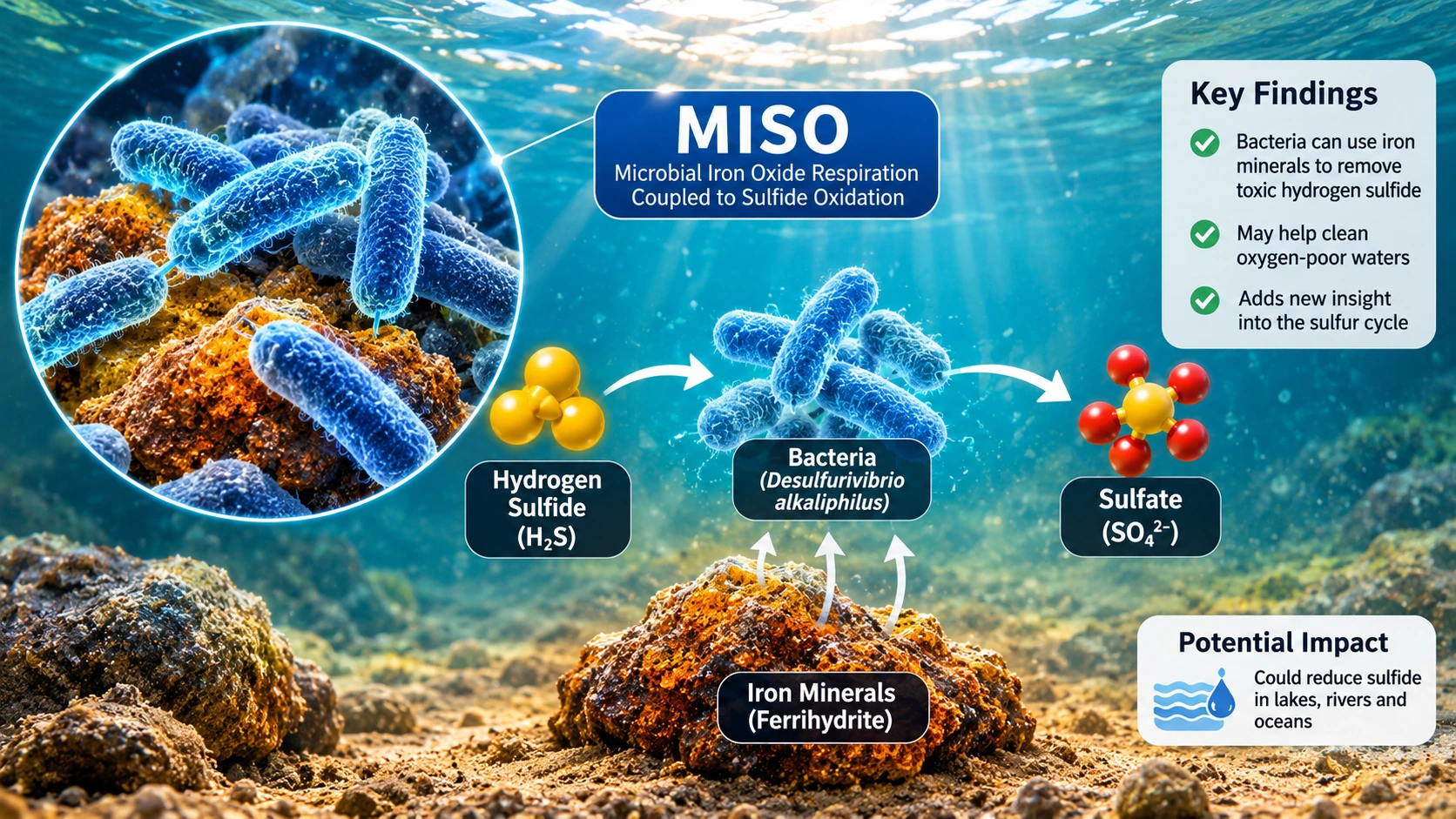
A bacterium found in oxygen-poor environments can use iron minerals to turn toxic sulfide into sulfate, according to research published in Nature in August 2025. The international team behind the study identified a process called MISO, in which bacteria use a reaction involving iron and sulfide to obtain energy.
The finding offers a different explanation for a reaction that scientists had generally treated as a chemical process. It also adds to existing knowledge of the sulfur cycle, particularly how iron and sulfur interact in places where oxygen is limited. The discovery could help researchers better understand natural hydrogen sulfide removal in aquatic environments.
How the bacteria use iron minerals
The team studied Desulfurivibrio alkaliphilus, a bacterium that can grow using ferrihydrite, a solid iron (III) mineral. During the process, the mineral accepts electrons from the reaction as the bacterium oxidises sulfide. The researchers called this process microbial iron oxide respiration coupled to sulfide oxidation, or MISO.
In laboratory experiments, the bacterium converted more than 90% of the sulfide into sulfate when it received repeated small doses. The researchers also observed that the biological reaction was faster than the corresponding chemical reaction at low sulfide concentrations.
The result reveals a previously unrecognised way for bacteria to gain energy from iron and sulfur reactions. It adds another example to the study of microbial metabolism, especially in environments where oxygen is unavailable.
The full findings appear in the Nature research paper.
Possible implications for aquatic ecosystems
Hydrogen sulfide can accumulate in sediments beneath lakes, rivers and oceans when oxygen levels are low. Its presence can create difficult conditions for aquatic organisms. The University of Vienna said the newly identified bacterial activity may help remove some of this toxic compound and could have implications for low-oxygen dead zones.
The researchers estimated that MISO might account for 1% to 7% of sulfide oxidation to sulfate in marine sediments worldwide. This is a calculated estimate, not a measurement of the process across the world's oceans. Its actual contribution in different habitats remains to be investigated.
The team also examined the genetic information of other microorganisms. Their analysis identified the potential for related iron-dependent sulfur processes across 37 bacterial and archaeal phyla. This points to a wider possible distribution of the process, although the researchers have not confirmed MISO activity in every group.
Another observation concerned carbon. The studied bacterium was able to fix carbon dioxide while growing through MISO, using inorganic carbon to produce material for its cells.
The findings give scientists a new process to investigate when studying oxygen-deprived environments. Further work will be needed to establish how often MISO occurs in nature and whether it can make a measurable difference to aquatic ecosystems.
Source: University of Vienna
Frequently Asked Questions
1. What is MISO in bacterial activity?
MISO is a process in which bacteria use solid iron minerals while oxidising sulfide. The reaction allows them to obtain energy for growth.
2. Which bacterium was used in the study?
The researchers conducted their experiments with Desulfurivibrio alkaliphilus, which can use ferrihydrite during sulfide oxidation.
3. How does MISO convert sulfide into sulfate?
The bacterium transfers electrons from sulfide to solid iron (III) oxide. Under the tested conditions, this activity resulted in the formation of sulfate.
4. Could this process help aquatic environments?
It may help control sulfide accumulation in oxygen-poor sediments. However, its effect on natural dead zones has not yet been established.
5. What did researchers discover about other microorganisms?
Genomic analysis identified the potential for related iron-dependent sulfur processes across 37 bacterial and archaeal phyla. Further experiments are needed to confirm their activity.
Browse our most recent publications