Startup Ecosystems Are Growing Beyond Silicon Valley
Latest Updates



visionaries Network Team
08 October, 2026
Beyond Silicon Valley
For decades, Silicon Valley was the obvious destination for ambitious technology founders. Venture capital, experienced engineers, major technology companies, and a deep pool of investors made the San Francisco Bay Area difficult to compete with. That picture has not disappeared, but it has become much bigger.
In 2026, startup ecosystems are developing across cities that have their own talent, industries, research institutions, and sources of capital. Startup Genome's latest report covers more than 350 entrepreneurial innovation ecosystems and 5.5 million companies. Mumbai now ranks as the world's number one emerging startup ecosystem, according to the Startup Genome 2026 Global Startup Ecosystem Report.
The change is not about finding a replacement for Silicon Valley. It is about recognizing that different cities can build successful technology communities around their own strengths.
Mumbai Shows How the Map Is Changing
Mumbai's position at the top of Startup Genome's 2026 emerging ecosystem ranking is significant. The city already has one of India's strongest financial sectors, a large corporate base, and access to investors and technology talent.
It is also part of a wider Indian shift. Bengaluru remains one of the world's leading startup centers and is ranked among the global top 15 by Startup Genome. But companies are increasingly being built across several Indian cities rather than in one location.
Hyderabad is a good example. The city has developed a strong technology and life-sciences base, with Genome Valley hosting international pharmaceutical companies and a growing concentration of technology operations. In 2026, L'Oréal announced plans for its first global technology hub in Hyderabad, adding to the city's growing technology profile.
This mix of established industry, skilled workers, research, and large companies gives Hyderabad something valuable to startups: an existing business ecosystem to build around.
Pittsburgh Is Building Around Robotics
Pittsburgh provides a different model. The city is not trying to compete with Silicon Valley as a general-purpose software center. Instead, it is developing a reputation around robotics, artificial intelligence, and physical technology.
Carnegie Mellon University is central to that story. The university's robotics research has helped create a deep pool of engineers and researchers, while local investors and entrepreneurs have built companies around that talent.
The region now has more than 700 startups, according to Allegheny County's Department of Economic Development. Octant Systems, for example, is working on AI-powered simulation technology. Local technology leaders increasingly see Pittsburgh's smaller size as an advantage because founders, researchers, investors, and public officials can interact more easily.
That is an important lesson for other cities. A technology hub does not have to cover every industry. It can become valuable by becoming exceptionally good at one area.
Europe Has Its Own Success Stories
Europe is also producing companies that challenge the idea that global technology businesses need to move to California.
Stockholm-based Lovable is one of the clearest recent examples. The AI software company reached a reported valuation of $13.3 billion in 2026. London-based ElevenLabs, meanwhile, reached an $11 billion valuation earlier this year and later passed $500 million in annual recurring revenue.
Their growth is particularly interesting because both companies are operating in markets with strong engineering and research talent but without Silicon Valley's traditional venture capital concentration.
Stockholm is also gaining ground at the ecosystem level. Startup Genome says the city climbed eight positions in its 2026 global ranking to number 23, tying with Amsterdam-Delta.
WIPO's 2026 innovation-cluster research provides another view of Europe's strength. Eindhoven and Helsinki rank among the European Union's most innovation-intensive clusters, followed by Stockholm, Copenhagen, and Munich.
These cities show that strong research, engineering, patents, and venture investment can create competitive technology centers without copying the Silicon Valley model.
Emerging Tech Hubs Are Gaining Momentum
The rise of emerging tech hubs is also visible outside the established European and North American centers.
Abu Dhabi's ecosystem value increased by $69 billion, the largest increase among the emerging ecosystems tracked by Startup Genome in 2026. Sri Lanka recorded the biggest overall jump in the Top 100 Emerging Ecosystems, climbing more than 65 positions. Auckland also moved more than 75 positions into the 31–40 range.
Riyadh has also made a substantial move. StartupBlink's 2026 city data shows the Saudi capital climbing 30 positions to 42nd globally, with its ecosystem score increasing by 117.6%. Singapore, already a major technology center, entered the global top 10 after recording 26.7% annual growth.
Southeast Asia is seeing another interesting development. Technology activity that was once concentrated in capitals such as Singapore, Jakarta, Bangkok, and Manila is beginning to spread toward secondary cities. Better digital infrastructure, local talent, and growing demand are helping these locations attract more technology businesses.
Location Still Matters, But Differently
The growth of these cities does not mean geography has stopped mattering. it means the reasons for choosing a location have changed.
A founder working on robotics may benefit from being close to a university with specialist engineering expertise. A fintech company may want access to financial institutions and regulators. A biotechnology startup needs research facilities and scientific talent. An AI company may prioritize engineers, researchers, computing infrastructure, and investors who understand the sector.
This is why the next generation of technology centers may look very different from one another. Silicon Valley still holds the number one position in Startup Genome's 2026 global ranking, with New York and London following behind. But the same report also shows a much wider group of cities gaining momentum.
For founders, that creates more choices. For investors, it creates new places to look for talent and companies. And for cities, it creates an opportunity to build an ecosystem around the capabilities they already have.
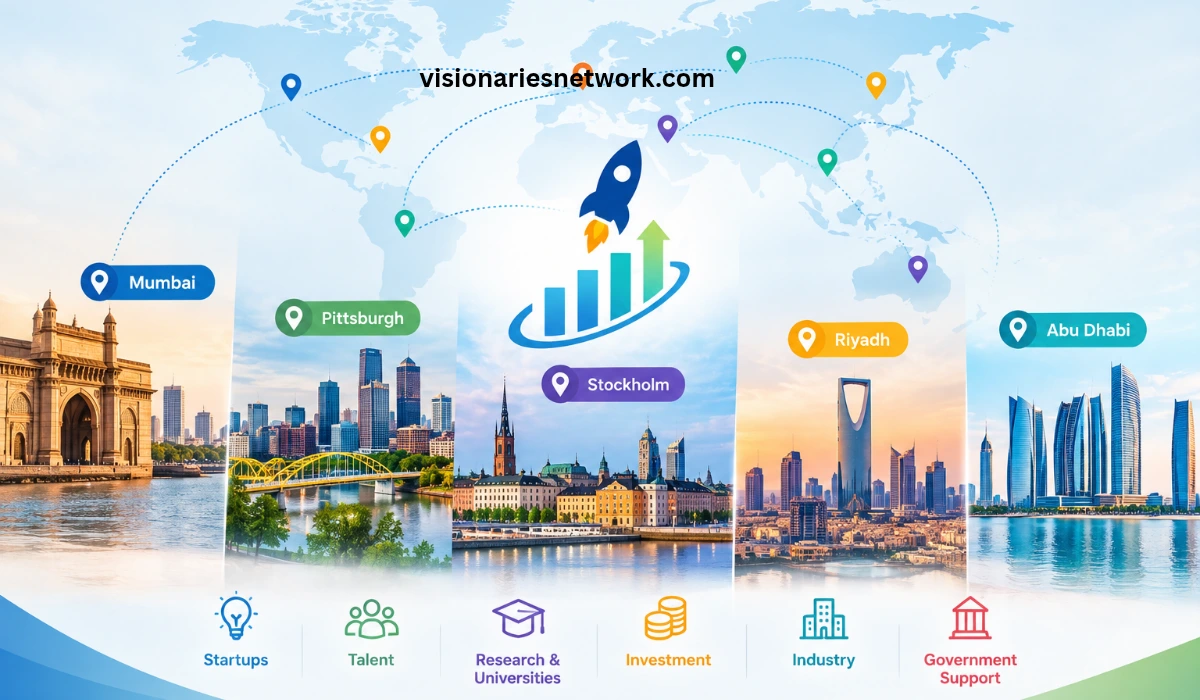
The global startup map is becoming less concentrated. The next major technology company could still come from Silicon Valley, but it could just as easily emerge from Mumbai, Pittsburgh, Stockholm, Riyadh, Abu Dhabi, or a city that is only beginning to attract attention.
FAQs
1. What is a startup ecosystem?
A startup ecosystem is a network of startups, investors, universities, companies, government organizations, talent, and other groups that support entrepreneurship in a particular location.
2. Which cities are emerging as startup hubs in 2026?
Mumbai, Detroit, Abu Dhabi, Riyadh, Auckland, Stockholm, Pittsburgh, and several secondary cities in Southeast Asia are among the locations showing notable momentum in 2026.
3. Is Silicon Valley still the leading startup ecosystem?
Yes. Startup Genome continues to rank Silicon Valley as the world's leading startup ecosystem in 2026. However, other cities are gaining ground and developing strengths in specific industries.
4. Why are startups growing outside Silicon Valley?
Access to skilled talent, universities, industry expertise, government support, lower operating costs, and improving access to investment are helping companies grow in more locations.
5. What industries are driving new technology hubs?
AI, robotics, fintech, biotechnology, cybersecurity, advanced manufacturing, and other deep-tech fields are helping cities develop specialized technology communities.
About the Company
Visionaries Network helps businesses and leaders strengthen their visibility through strategic PR, media exposure, and thought leadership.
Browse our most recent publications