Startups Advancing Materials Science with New Discoveries
Latest Updates





visionaries Network Team
07 October, 2026
semiconductors
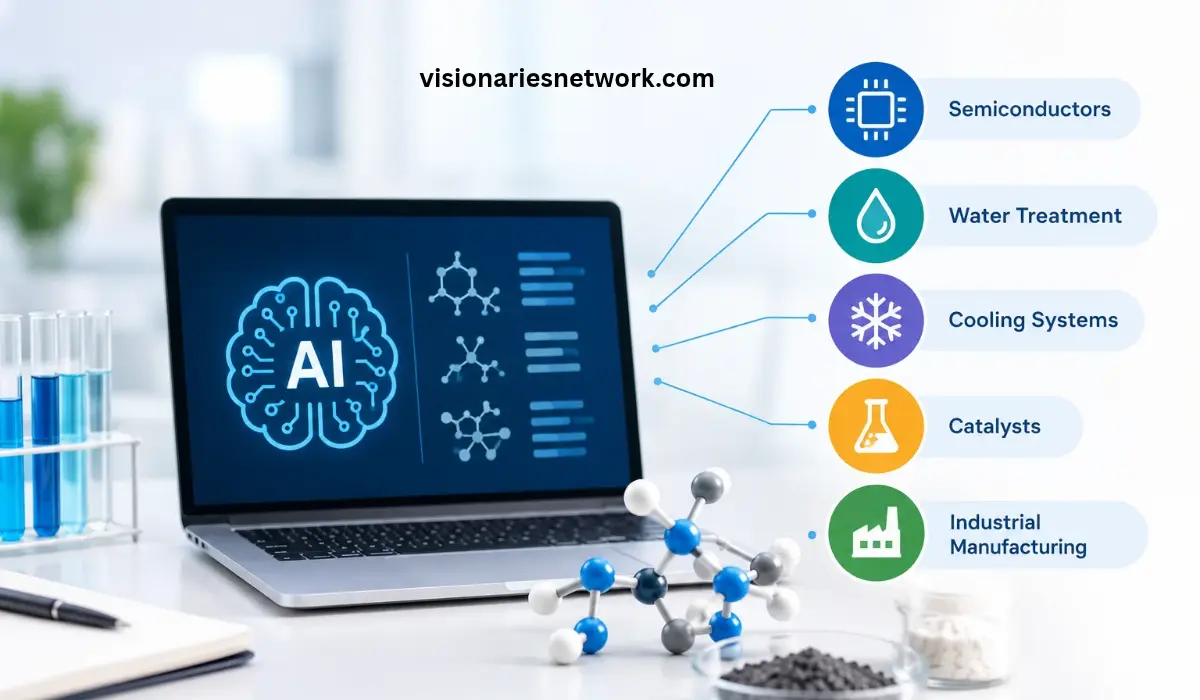
Finding a new material is rarely a quick process. Researchers can spend years testing chemical combinations, studying their properties, and working out whether they can be produced at a reasonable cost. Several young companies are now changing the early stages of that work by searching through huge numbers of possible compounds before laboratory testing begins. Their efforts are already reaching semiconductors, water treatment, cooling systems, catalysts, and industrial manufacturing, creating new opportunities in materials science.
CuspAI Searches a Massive Chemical Space
CuspAI is working on one of the most difficult parts of material development: deciding where researchers should look first.
The UK-based company develops systems that can search for materials based on the properties required for a particular application. One of its projects with Finnish chemicals company Kemira involved materials that could remove PFAS, commonly known as “forever chemicals,” from water.
The scale of that search was enormous. The companies examined a design space of about 300 trillion possible material structures and produced more than 5,000 new material designs for three priority PFAS molecules. The project moved from a process expected to take years to roughly six months.
CuspAI has also attracted significant investment. Reuters report on CuspAI's $450 million funding round reported in July 2026 that the company raised $450 million in Series B funding at a valuation of about $2.6 billion. CuspAI also launched its AI Materials Foundry, bringing together more than 45 companies.
The important part is what happens after the computer search. Candidates still have to be produced and tested. The value is in giving scientists a much larger starting point than conventional trial and error.
Discovered Materials Looks at the Heat Problem
Discovered Materials has chosen a narrower target: materials for semiconductor thermal management.
Modern chips generate considerable heat, particularly when used for demanding computing workloads. Managing that heat is becoming an important engineering issue for chip and data-center companies.
The startup raised $9 million in seed funding in 2026 after emerging from Y Combinator, according to TechCrunch's report on Discovered Materials. Its Material Discovery Bench is focused on finding materials that could improve the performance of semiconductor systems.
The company says it has already identified several materials with properties comparable to substances used in existing semiconductor applications, although it has not disclosed their full details.
There is also a practical challenge. A material may have excellent thermal properties but still be unsuitable if it cannot be manufactured alongside other chip components. That is why laboratory validation remains an important part of the process.
For Discovered Materials, the goal is not simply to produce a long list of possibilities. The company wants to find materials that can eventually work in real semiconductor applications.
Orbital Industries Takes Its Work into Data Centers
Orbital Industries is approaching the market from a more commercial direction. The company has been developing materials for data-center cooling, an area that has become increasingly important as computing equipment becomes more powerful. Its work includes a PFAS-free cooling material designed for high-density computing environments.
Fortune's report on Orbital Industries reported in May 2026 that the company raised $50 million in Series B funding. Rather than selling its software as a standalone product, Orbital plans to use its technology internally to develop materials and physical products.
The company has also moved into catalyst development. In August 2026, BASF Environmental Catalyst and Metal Solutions agreed to license Orbital's CurieOS platform for catalyst innovation.
That partnership puts the technology directly into an established industrial setting. Catalysts are used in numerous chemical and automotive processes, so improvements can have an impact on production efficiency and emissions control.
Newfound Materials Focuses on How Materials Are Made
Finding a promising material is only half the challenge. Manufacturers also need to know whether they can produce it efficiently.
Newfound Materials is working on this part of the problem. Its research examines possible reaction pathways and helps identify routes that can then be tested experimentally.
A 2026 study involving Newfound Materials and Colorado State University looked at the production of monoclinic bismuth vanadate, or BiVO₄. Researchers used computational thermodynamic screening to identify alternative synthesis routes.
The results were notable. All six selected reactions produced BiVO₄ at 500°C with less than 1% impurities. The work was published in Inorganic Chemistry by the American Chemical Society.
The result matters because manufacturing conditions can determine whether a material is commercially useful. A process that requires less heat can potentially reduce energy requirements and change the economics of production.
This is an important part of materials research. The question is not simply whether a substance can be created, but whether it can be made consistently and economically.
Research Is Moving Closer to Automated Testing
The same shift can be seen in academic laboratories. The University of Toronto and National University of Singapore have been developing the Materials Data Foundry with industry partners, combining computational work with robotics and physical measurements. Areas of interest include materials beyond silicon, electrocatalysts, and high-entropy alloy coatings.
Government research is moving in a similar direction. The U.S. National Institute of Standards and Technology has worked on automated materials searches that examine different compositions and temperatures.
These developments point toward a more connected research process. Instead of spending large amounts of time testing every possibility, researchers can narrow the field first and then put selected candidates through physical experiments.
Where the New Materials Could Be Used
The Real Test Is Commercial Use
The startups in this field still face a difficult final step. A promising result in a computer model or laboratory does not automatically become a commercial product.
For companies working in materials science, the commercial opportunity lies in turning these discoveries into products that can be manufactured at scale.
Manufacturing costs, availability of ingredients, durability, safety, and performance under real operating conditions all matter.
That makes the partnerships being formed by these startups particularly important. CuspAI is working with chemicals and technology companies, Orbital Industries has moved into catalyst development with BASF, and Discovered Materials is concentrating on semiconductor applications.
Investment is another sign that investors see commercial potential in the sector. But the more meaningful milestone will be the arrival of these materials in products and industrial processes.
The early stage of materials discovery is becoming much broader. Researchers can investigate possibilities that would have been difficult to examine through conventional laboratory work alone. The companies that can turn those possibilities into affordable, manufacturable products may ultimately have the strongest advantage.
FAQs
1. What are these startups trying to achieve?
They are looking for new materials and chemical compounds that can solve practical problems in areas such as semiconductors, cooling, water treatment, and manufacturing.
2. Why does finding new materials take so long?
Researchers often have to test many combinations before finding one with the right properties. They also need to determine whether the material can be produced safely and affordably.
3. Which industries could benefit from these discoveries?
Semiconductors, chemicals, data centers, water treatment, energy, and advanced manufacturing are among the industries that could benefit from better materials.
4. Why is the way a material is produced important?
A material may work well but still be difficult or expensive to manufacture. A simpler production process can make it more useful for commercial applications.
5. Are these discoveries already being tested in real applications?
Yes. Startups are working with companies and research institutions on areas including semiconductor cooling, chemical production, water treatment, catalysts, and industrial materials.
About the Company
Visionaries Network is a business media and PR platform covering emerging companies, technologies, industry trends, and business leaders worldwide.
Browse our most recent publications