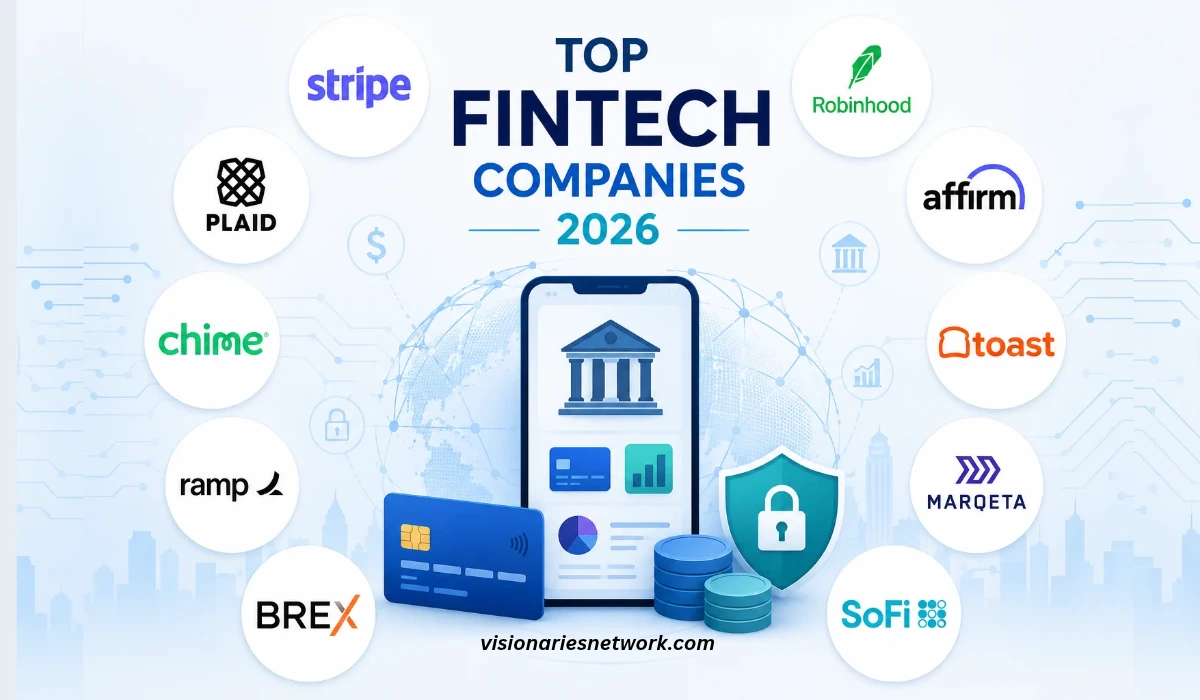
Top Fintech Companies to Watch for in 2026
Latest Updates






visionaries Network Team
20 August, 2026
banking and fintech
Money has become increasingly digital, but that does not mean financial services have become simple. Behind a payment, a loan application, an investment account, or a business expense are systems that need to work quickly and securely. The Top Fintech companies 2026 will be the ones making those systems easier to use while solving problems that banks, businesses, and consumers deal with every day. Some are building payment infrastructure, some are changing digital banking, and others are bringing financial tools into software people already use.
Fintech has also moved well beyond the idea of putting a bank account on a smartphone. Instant payments, for example, are becoming an important part of the financial infrastructure, allowing money to move between accounts within seconds Federal Reserve's explanation of instant payments. Companies are now working across payments, lending, investing, fraud prevention, financial data, corporate spending, and embedded finance. At the same time, artificial intelligence is giving these businesses new ways to analyze information and automate routine financial work.
· Stripe
Stripe continues to be one of the most closely watched names in financial technology. Its payment infrastructure allows businesses to accept payments and manage different parts of their financial operations without building those systems themselves.
The company has gradually expanded beyond online payments. Billing, invoicing, fraud prevention, financial accounts, and other services have become part of its broader platform.
Its recent interest in artificial intelligence also shows where the company sees future opportunities. In August 2026, Stripe agreed to acquire OpenRouter, an AI platform that gives developers access to multiple AI models. The deal points to a wider connection between financial infrastructure and the software businesses are using to build AI products.
Stripe's scale is another reason to keep it on the radar. Businesses on the platform generated $1.9 trillion in total payment volume during 2025, according to Reuters.
· Plaid
Many consumers may not recognize Plaid's name, but they may have used its technology without realizing it. Plaid connects financial accounts with applications, allowing users to securely share financial information with services they choose.
Its technology supports personal finance applications, lending platforms, payment services, and other financial products.
Plaid is taking a particularly interesting approach to artificial intelligence. The company has been working on financial data models that can help with tasks such as understanding transactions, identifying fraud, improving credit decisions, and giving consumers better financial information.
The company has also expanded its work with AI companies. Its integration with Perplexity, for example, is aimed at giving users more personalized financial insights by connecting their financial accounts.
This puts Plaid in an important position as financial data becomes more useful to AI-powered applications.
· Chime
Chime has built its business around making everyday banking accessible through a digital-first experience. Its products are designed for consumers who want to manage spending, deposits, payments, and other basic financial needs through their phones.
The company has continued to grow. In August 2026, Chime raised its full-year revenue growth forecast to between 25% and 26%. It reported second-quarter revenue of $670 million and said active members had reached 10.4 million, up 20% from the previous year.
Chime is also an example of how AI is beginning to influence the business side of fintech. The company announced plans in 2026 to reduce its workforce by roughly 10%, citing efficiency gains associated with AI.
For the wider industry, Chime is worth watching because its progress reflects the continuing demand for simple digital banking products.
· Ramp
Ramp is tackling a very different financial problem: how companies control and understand their spending.
Its platform brings together corporate cards, expense management, accounts payable, procurement, and other financial processes. Instead of relying on several separate systems, businesses can manage much of their spending activity through one platform.
That approach has become increasingly attractive to finance departments. Companies want more than a record of what employees have purchased. They want to know where money is going, whether expenses are necessary, and where processes can be automated.
AI could make this type of software even more useful. Rather than simply presenting financial information, future systems can identify unusual spending patterns, flag unnecessary expenses, and assist finance teams with routine decisions.
· Brex
Brex is another company changing how businesses handle corporate finance. It offers corporate cards and software covering areas such as expenses, travel, payments, and financial management.
The important development here is the move from financial products to financial platforms. A corporate card by itself is useful, but combining the card with spending controls, expense tracking, travel management, and reporting creates a much broader service.
For growing companies, having those functions connected can reduce the administrative work involved in managing employee spending.
Brex is therefore worth watching as businesses continue replacing disconnected financial tools with integrated platforms.
· Robinhood
Robinhood helped change the way many people think about investing. Its mobile-first approach made buying and selling financial assets more accessible to a generation of consumers who were not necessarily traditional brokerage customers.
The company has since expanded its ambitions. Its offerings now cover areas including investing, retirement, cryptocurrency, and other financial services.
That expansion matters because fintech companies increasingly want to become the place where customers manage several parts of their financial lives. Once a customer is already using an application for investing, adding other services becomes a natural next step.
Robinhood's progress will show how far a consumer-focused fintech platform can expand without losing the simplicity that originally attracted its users.
· Affirm
Affirm is one of the better-known companies in the buy now, pay later market. Its platform allows consumers to split eligible purchases into scheduled payments while giving merchants another way to offer financing at checkout.
The service has become part of the online shopping experience rather than something consumers necessarily seek out separately.
That is an important characteristic of modern fintech. Financial services do not always need to look like financial services. Payments, lending, insurance, and other products can increasingly sit inside the websites and applications people already use.
Affirm will be worth following as the BNPL industry continues to mature and questions around consumer protection, responsible lending, and transparency receive greater attention.
· Toast
Toast demonstrates how fintech can be built around a specific industry.
The company provides restaurants with point-of-sale technology, payment processing, payroll, marketing tools, and other business services. Its approach is different from that of a general-purpose financial platform because the products are designed around the day-to-day needs of restaurants.
A restaurant needs to process payments, but it also needs to manage orders, employees, menus, customers, and other operations. Bringing these functions together gives Toast a deeper role in the businesses using its platform.
This type of industry-specific fintech could remain an important growth area as more companies look for financial tools that understand their particular business models.
· Marqeta
Marqeta operates largely behind the scenes. Its technology allows businesses to create and manage card programs and other payment products.
This is particularly relevant to embedded finance. A retailer, marketplace, technology company, or other platform may want to offer financial services to customers without becoming a traditional bank.
Companies such as Marqeta provide much of the infrastructure needed to make that possible.
As more businesses add financial features to their existing products, this infrastructure layer could become increasingly important. It also illustrates how fintech is no longer limited to companies that market themselves directly as financial brands.
· SoFi
SoFi has taken the digital finance model in another direction. The company started with student lending and gradually expanded into a broader range of financial products.
Today, its platform includes lending, banking, investing, and other services. The strategy reflects a broader change in consumer finance: people increasingly want to manage different financial needs from one place.
For SoFi, the challenge is balancing that wider range of services with a straightforward customer experience.
Its development also offers a useful example of how fintech companies can grow by building on an existing relationship rather than launching completely separate products.
What the market is watching
The Top Fintech Companies in USA are operating in a market where customer expectations have changed considerably. Speed is important, but it is no longer enough. People also expect security, clear information, reliable service, and products that fit naturally into their daily routines.
Artificial intelligence is becoming part of that equation. It can help financial companies sort large amounts of data, identify suspicious activity, answer customer questions, and automate repetitive work. But it also creates new concerns, particularly around privacy, accuracy, fraud, and how financial decisions are made.
Fraud prevention is likely to remain one of the biggest areas of focus. As technology makes scams more sophisticated, fintech companies need stronger systems to distinguish legitimate activity from suspicious behavior.
Open banking is another area worth watching. Giving consumers greater control over their financial information can encourage competition and create new products, but it also requires strong security and clear consent mechanisms.
Why these companies matter in 2026
The companies worth following are not all chasing the same opportunity. Stripe is building financial infrastructure for businesses. Plaid is working at the intersection of financial data and technology. Chime is focused on everyday digital banking, while Ramp and Brex are tackling corporate spending.
Robinhood and SoFi are expanding consumer financial platforms. Affirm is focused on payments and consumer financing. Toast shows what industry-specific fintech can look like, while Marqeta provides infrastructure for companies building financial products of their own.
Together, they reflect where the industry is heading. Fintech's next stage will probably be less about replacing traditional financial services overnight and more about improving the individual parts of the financial experience. A payment should take less effort. A business expense should require less paperwork. Financial information should be easier to understand. Fraud should be detected earlier. And financial products should fit more naturally into the software people already use.
The Top Fintech Solution Providers in 2026 will ultimately be judged by how well they handle those everyday problems. Technology may sit behind the product, but customers will care about something much simpler: whether the service saves them time, gives them more control, and works when they need it.
FAQs
1. What are some fintech companies to watch in 2026?
Stripe, Plaid, Chime, Ramp, Brex, Robinhood, Affirm, Toast, Marqeta, and SoFi are all interesting names this year. They cover different parts of finance, so there is no single trend connecting them all.
2. What is happening in the fintech industry in 2026?
Payments are getting faster, more financial services are moving online, and companies are finding new ways to build banking and payment features into their own products. Fraud is another big concern as financial transactions continue to move online.
3. Where does AI fit into fintech?
AI is being used for plenty of behind-the-scenes work. A fintech company might use it to flag a suspicious transaction, sort through documents, or deal with routine customer requests. Some companies are also testing AI for personal financial guidance.
4. What is embedded finance?
The idea is fairly simple. A company adds a financial service to something it already offers. A retailer might provide financing at checkout, for example, while a business software provider could add payments to its platform.
5. How can a business choose the right fintech provider?
Start with what the business actually needs. Check the cost, security, customer support, integrations, and reliability. A provider that works well for a small online business may not be the right choice for a company processing thousands of transactions every day.
About the company
Visionaries Network features business leaders and professionals who are making a difference in their industries. Its content focuses on their work, leadership, achievements, and the ideas they bring to their respective fields.
Browse our most recent publications