Direct Lithium Extraction Could Reshape the Global Battery Supply Chain
Latest Updates



visionaries Network Team
22 September, 2026
Environment Power and Clean Energy
Lithium has quietly become one of the most important raw materials behind the shift toward electric mobility and renewable energy storage. It sits inside the batteries that power electric cars, store solar energy and run countless electronic devices. But getting enough lithium out of the ground and into battery manufacturing is becoming a bigger challenge. That is where direct lithium extraction is drawing attention.
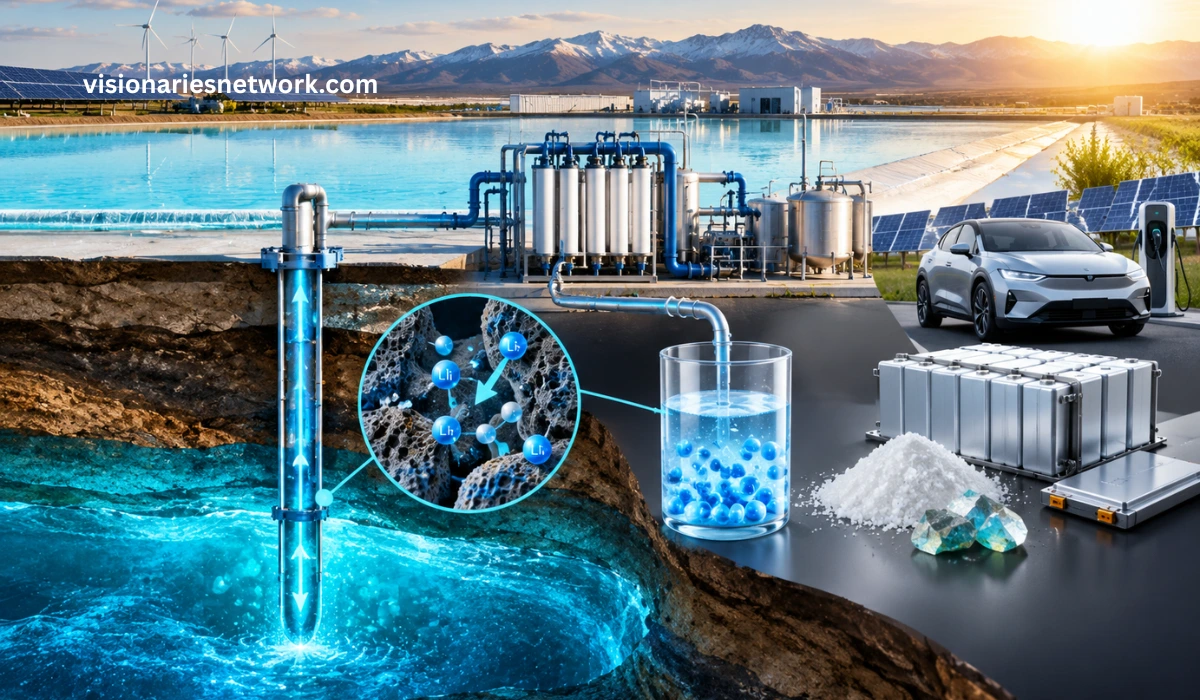
Unlike traditional lithium production, which can rely on large evaporation ponds or conventional mining, DLE aims to separate lithium directly from underground brines. The idea is relatively straightforward, but making it work reliably and economically on a large scale is far more complicated. Companies around the world are now trying to prove that the technology can move from promising pilot projects into commercial production.
A Different Way to Get Lithium from Brine
Much of the world's lithium comes either from hard-rock mining or from brines. In conventional brine operations, lithium-rich water is pumped to the surface and placed in evaporation ponds. Sunlight and time gradually remove the water, leaving behind a more concentrated material that can be processed further.
DLE takes another route. Instead of waiting for evaporation to do the concentrating, the process uses specially designed materials or separation systems to pull lithium from the brine. Depending on the project, the process may use adsorption, ion exchange, membranes or electrochemical techniques.
The U.S. Department of Energy has been supporting research into these methods, particularly in areas where lithium-bearing geothermal fluids and other brines could provide another source of domestic supply. Its work on geothermal lithium explains how selective extraction can potentially recover lithium while allowing treated brine to be returned underground. U.S. Department of Energy geothermal lithium research
The attraction is clear. A successful system could require less land than huge evaporation ponds and could potentially recover lithium much faster. But those advantages still have to hold up when the equipment is running continuously and dealing with real-world brine chemistry.
Companies Are Putting the Technology to the Test
The growing number of direct lithium extraction companies shows how much interest the field has generated. Developers are approaching the problem from different directions, with projects involving geothermal brines, oilfield-produced water and other lithium-bearing resources.
One recent development came from Vulcan Energy. In September 2026, the company announced that it had begun commercial-scale production of VULSORB, an adsorbent designed for its DLE process. The material is intended for Vulcan's Lionheart project in Germany, which the company plans to commission in the second half of 2028. Mining Weekly report on Vulcan Energy's DLE development
Developments like this matter because the industry is moving into a stage where demonstrations need to translate into actual production. A technology can perform well in a laboratory and still face difficulties once it encounters large volumes of brine, changing operating conditions and the costs associated with a commercial plant.
Lithium extraction may happen far away from a battery factory, but the two industries are closely connected. Any disruption at the raw-material stage can eventually affect processors, cathode manufacturers, battery-cell producers and vehicle makers.
That is why battery supply chain discussions increasingly include questions about where lithium is produced and processed. The push for more diversified sources is already producing new partnerships.
In September 2026, Canadian lithium developer E3 Lithium announced an agreement framework with India's Epsilon CAM covering potential supplies of battery-grade lithium carbonate from its Alberta project. The proposed arrangement illustrates how lithium producers and battery-material manufacturers are trying to establish links across different regions.
For countries seeking greater control over their battery industries, having access to lithium closer to home can be important. It does not eliminate the need for international trade, but it can give manufacturers more options when sourcing a critical raw material.
The Technology Still Has Plenty to Prove
There is no single version of DLE. Different companies use different materials and processes, and the performance of each system depends heavily on the brine being treated.
That makes lithium extraction technology an interesting area to watch. Developers need to achieve a useful recovery rate without consuming excessive amounts of energy, water or chemicals. They also need equipment that can operate reliably for long periods.
Environmental questions are part of the conversation as well. DLE is sometimes presented as a lower-impact alternative to conventional brine production, but the actual footprint depends on the process and the resource. Energy requirements, water management, chemical use and brine reinjection all need to be considered on a project-by-project basis.
The technology therefore should not be treated as a shortcut around the challenges of lithium production. It is another set of tools that could make some resources more practical to develop.
A More Complicated Lithium Supply Chain
The lithium supply chain has become an important strategic issue as demand for batteries continues to grow. Lithium may be mined or recovered in one country, processed in another and eventually incorporated into batteries somewhere else. Each stage adds another link and another potential point of disruption.
China remains a major force in the processing of critical minerals, while the United States, Europe, Canada and other regions are working to develop alternative sources and processing capacity. Recent reporting from Reuters has highlighted the competition surrounding critical-mineral supply chains and efforts by governments to reduce vulnerabilities.
DLE could fit into this picture by making additional lithium resources commercially useful. Geothermal areas, for example, may contain lithium in their brines alongside their existing energy potential. Other projects are examining produced water associated with oil and gas operations. The bigger question is whether these sources can deliver enough material at a competitive cost.
What It Could Mean for Future Batteries
The lithium battery supply chain depends on much more than the availability of lithium. Processing capacity, battery-grade chemicals, cathode materials, cell manufacturing and transportation all play a role. Still, the raw material remains an important starting point.
If DLE projects can achieve commercial scale, they could add more sources to that system. That could be particularly useful for regions that have lithium-bearing resources but lack the conditions needed for conventional evaporation-based production.
It could also change how companies think about previously overlooked resources. A brine that once appeared too difficult or expensive to process might become more interesting if a selective extraction system can recover lithium efficiently.
Commercial Results Will Tell the Story
For now, DLE remains an evolving part of the lithium industry rather than a replacement for established production methods. There are promising projects, significant investment and growing government interest, but large-scale commercial performance will ultimately determine how widely the technology is adopted.
The coming years will show whether DLE can consistently deliver battery-grade lithium at a cost that makes sense for producers and manufacturers. If it can, the impact could extend well beyond the extraction site.
More lithium sources would give battery manufacturers additional options, while countries could gain another route toward strengthening their domestic mineral industries. For an industry under pressure to expand quickly while making its raw-material networks more resilient, that possibility makes direct lithium extraction one of the developments worth following.
Frequently Asked Questions
1. What is direct lithium extraction?
Direct lithium extraction is a group of processes that selectively remove lithium from brines and other lithium-bearing fluids. Depending on the technology, companies may use adsorption, ion exchange, membranes or electrochemical methods.
2. How is DLE different from traditional lithium extraction?
Traditional brine production can use large evaporation ponds to concentrate lithium over time. DLE uses a separation process to extract lithium more directly from the brine, potentially reducing land requirements and shortening processing times.
3. Which companies are developing DLE?
Several direct lithium extraction companies are developing different approaches, including projects based on geothermal brines and other underground fluids. Their technologies and commercial development stages vary.
4. Can DLE strengthen battery supply?
Potentially. If DLE makes additional lithium resources commercially viable, it could add new sources to the battery supply chain and give manufacturers more options when sourcing raw materials.
5. Will DLE replace traditional lithium mining?
There is no indication that it will replace every existing production method. Hard-rock mining, conventional brine production and DLE could all contribute to future lithium supply, depending on the resources and economics involved.
About the Company
Visionaries Network is a business media and PR platform for CEOs, founders, entrepreneurs, technology leaders, startups, and companies seeking industry visibility, recognition, and growth.
Browse our most recent publications