Affordable AI Robots Are Changing How Students Learn
Latest Updates





visionaries Network Team
28 August, 2026
iot and robotics
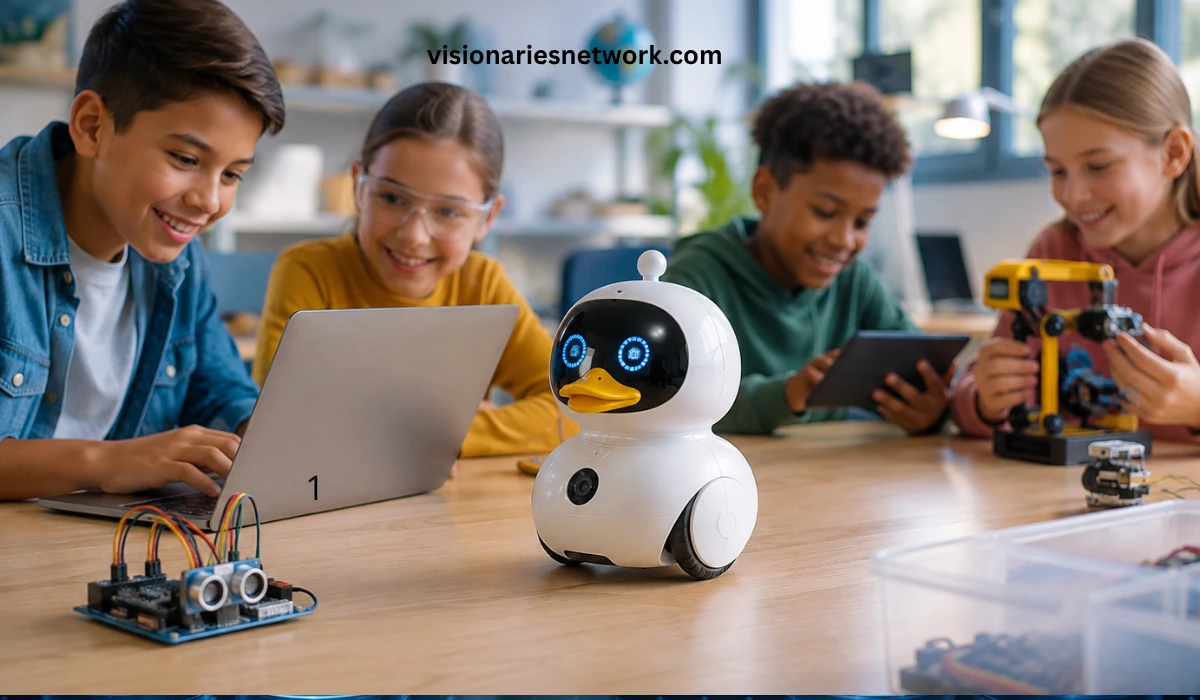
Robotics has been used in STEM education for years, but advanced machines have not always been practical for schools. The cost of the equipment can be a major barrier. That is starting to change as smaller and more affordable robots become available. Hugging Face's Microduck, which is priced at $399, is one example. The compact robot is designed for experimentation and robot learning, giving students another way to work with physical technology without needing a large humanoid machine. This could make affordable AI easier for schools to explore.
From Computer Screens to Real Machines
Writing code on a computer teaches students the basics, but controlling a physical machine adds another dimension to the lesson.
A student might write a simple program telling a robot to move forward. If the robot turns too far or stops in the wrong place, the student has to figure out what happened.
That turns a coding exercise into a practical problem. Students can check the code, examine the sensors, change a setting, and run the program again. Sometimes the first solution works. Sometimes it does not. Either way, students get to see how their decisions affect a real machine.
Microduck Shows Where Robotics Is Heading
Hugging Face's Microduck is an example of the growing interest in smaller robotics hardware.
The robot is around 10 inches tall and weighs less than two pounds. It has a camera, microphone, speaker, Wi-Fi, Bluetooth, sensors, and a small lidar sensor. Its beak can also pick up small objects. Hugging Face has designed Microduck for experimentation with robot learning and reinforcement learning.
For schools, the size and price could be important. A classroom does not necessarily need a large humanoid robot to teach students about robotics. A smaller machine can provide opportunities to explore programming, sensors, computer vision, and machine learning.
Students Learn by Testing Their Ideas
Robots make mistakes easy to see, imagine a student programming a robot to pick up an object. The instructions appear correct, but the robot misses it.
The student then has to work out why. Maybe the object was too far away, perhaps the camera did not identify it correctly, the robot may have moved too quickly, or a value in the program could be wrong.
There is no single answer in every situation, that is useful because students have to investigate instead of simply searching for a solution. They can change one thing, test it, and see whether the result improves.
For students who find programming abstract, this can make the subject easier to understand. They can see their code producing a physical result right in front of them.
Robotics Is Already Familiar to U.S. Students
American schools already have plenty of experience with robotics programs. FIRST, for example, has given students opportunities to build robots, program them, work in teams, and compete in practical challenges.
FIRST Robotics gives students hands-on experience designing, building, and programming robots while developing STEM and problem-solving skills. FIRST Robotics official website
Lower-cost AI robots could add another option to these existing programs. A school could purchase one machine and allow several groups to work with it.
One group could focus on programming, another could experiment with sensors, while a third could work on movement. Students would be sharing the equipment while learning from each other's work.
The Teacher Still Has an Important Role
Some people wonder whether robots could eventually replace teachers. That misses the more useful role these machines can play, a robot can demonstrate a task, follow instructions, or give students a challenge but it cannot provide the same judgment and support as a teacher.
If a student cannot work out why a robot is behaving incorrectly, the teacher can help them think through the problem. If an assignment is too difficult, the teacher can change it to suit the class.
That support matters because students do not all understand new ideas at the same pace. Robots are more useful when they give teachers another way to explain a concept and give students something practical to work with.
Robots Can Be Used Beyond Coding
Robotics does not have to stay inside a computer science class, a science teacher could use sensors to demonstrate movement or environmental conditions. Mathematics students could work with distance, angles, and measurements. Engineering students could examine how the machine is assembled and how its different parts work together.
Students could think about how people interact with robots and what makes a machine easy or difficult to use.
AI introduces another set of questions. Students can explore how a robot recognizes an object, responds to an instruction, or deals with information from its surroundings. These are practical ways to introduce concepts that can otherwise seem complicated.
The Cost Still Matters
A $399 robot is cheaper than many advanced systems, but schools still have to consider the full cost.
They may need computers, software, replacement parts, teacher training, and technical support. Schools also need to decide how many students will use the machine and how often it will be part of lessons.
Still, a lower purchase price can make experimentation more realistic.
A school that cannot justify buying an expensive humanoid robot may be willing to start with a smaller machine. If students use it regularly and teachers find it useful, the school can consider expanding its robotics program.
Privacy Is Another Concern
Cost is not the only issue schools need to consider. Many modern robots use cameras, microphones, and other sensors. When these devices are used around students, schools need to understand what information they collect and where that information goes.
Privacy policies should be reviewed before connected robots are introduced into classrooms. Schools also need clear rules for how students interact with the machines, making sure the technology is safe and appropriate should come before the excitement of having a new robot in the classroom.
What Students Can Take Away
The most valuable lesson may not be learning how to operate a particular robot, it may be learning how to approach a problem.
When students try to make a robot complete a task, they have to break the problem into smaller steps. They test an idea, look at the result, make a change, and try again.
That process can help students become more comfortable with difficult problems. The same approach can be useful when they study programming, engineering, mathematics, or science.
A Practical Future for Classroom Robotics
Interest in educational robots is growing as schools look for ways to give students more experience with AI and physical technology. Real-world developments in robotics are showing how quickly these machines are moving into everyday environments. For example, Weave Robotics' Isaac 1 is designed to assist with household tasks such as folding laundry, picking up clothes, and making beds, showing how AI-powered robots are being developed for practical, hands-on tasks. AI Home Robot Isaac 1 Unveiled by Weave Robotics
Schools do not necessarily need to begin with expensive humanoid machines. Smaller robots can provide a more manageable starting point. Students can program them, test different ideas, find mistakes, and see the results of their work.
As these machines become easier to access, robotics teaching could become a more common part of STEM education, giving students practical experience with technologies they are likely to encounter in the future.
FAQs
1. How can AI robots help students learn?
They give students practical experience with programming, sensors, robotics, and AI. Students can test their ideas and see the results on a physical machine.
2. What is Hugging Face's Microduck?
Microduck is a small robot from Hugging Face that is priced at $399 and designed for experimentation with robot learning and AI.
3. Can robots replace teachers?
No. Robots can support classroom activities, but teachers are still needed to explain concepts, guide students, and adjust lessons to their needs.
4. Which subjects can use educational robots?
Robots can be used in programming, science, mathematics, engineering, computer science, and other STEM-related activities.
5. What should schools consider before buying an AI robot?
Schools should look at the total cost, maintenance, teacher training, safety, privacy, and whether the robot will provide meaningful value to students.
About the company
Visionaries Network is a business and technology platform that highlights innovative companies, emerging technologies, and influential leaders shaping the future. Through its editorial coverage, it connects readers with ideas, insights, and organizations driving change across industries.
Browse our most recent publications