Physical AI Is Bringing Intelligence into the Real World
Latest Updates



visionaries Network Team
31 August, 2026
ai vr and automation
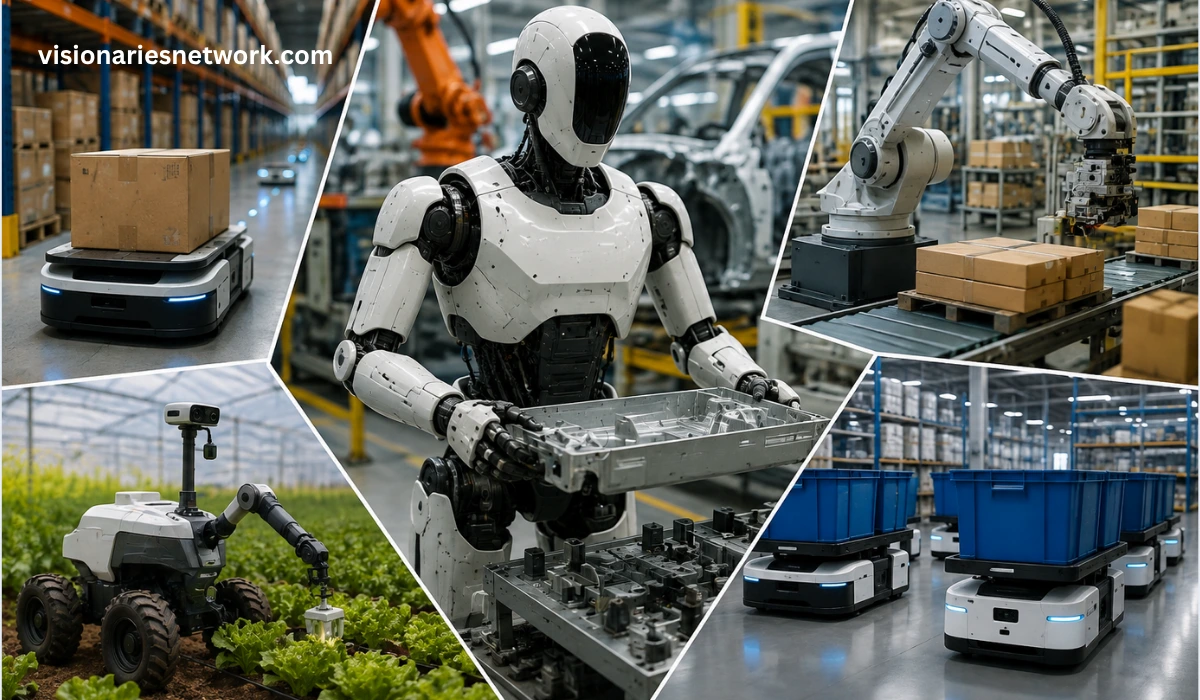
For years, artificial intelligence has mostly lived inside computers. It wrote emails, answered questions, analyzed documents, and generated images. Now companies are trying to give AI a body. Smart machinery is appearing in factories, warehouses, and other workplaces, where machines are expected to understand what is around them and respond without being told every step.
The idea is attracting serious investment because the physical world is still full of work that software cannot do. Someone still has to move a part, pick up a package, inspect a product, or carry materials across a factory. Robots have been doing some of these jobs for years. The difference now is that AI is making them more adaptable.
The Factory Floor Is Changing
BMW offers a useful example. The automaker has been testing humanoid robots in its manufacturing operations. At its Spartanburg, South Carolina, plant, BMW worked with Figure AI to test Figure 02. The robot was given a fairly straightforward job: handle sheet-metal parts and place them into a fixture used for welding.
The results were notable. During the ten-month trial, Figure 02 supported production of more than 30,000 BMW X3 vehicles. BMW says it moved more than 90,000 components and completed around 1.2 million steps over approximately 1,250 operating hours.
BMW has not stopped there. At its Leipzig plant in Germany, the company is testing AEON, a humanoid robot developed by Hexagon Robotics. The robot is being considered for activities including transporting materials and supporting production.
These projects are still pilots. That matters. The industry is not at the point where factories are filling up with humanoid workers. Companies are testing where these machines make sense and where they do not.
That is probably a more useful way to look at Physical AI.
A Robot That Can Deal with Change
Traditional industrial robots are very good at repetition. Give a robot arm the same part, the same position, and the same instructions, and it can repeat the job thousands of times. Problems arise when the conditions change.
AI can help with that problem. A camera can tell a machine that an object is not where it normally is. Sensors can provide information about distance, movement, or pressure. Software can use that information to decide what the machine should do next.
It is a relatively simple concept, but it opens up more possibilities. A warehouse robot, for example, may encounter packages in different positions. A factory machine may need to deal with parts that are slightly misaligned. A farming robot may have to distinguish a crop from a weed.
Instead of stopping whenever something is different, an AI-enabled machine can attempt to adjust. That ability is at the heart of the Physical AI push.
Amazon Is Already Using AI-Enabled Robots
Amazon's warehouses provide another example. The company has been using robots in its fulfillment centers for years. More recently, it has been combining those machines with computer vision, sensors, and AI.
One of its newer systems is Vulcan. Rather than simply moving around a warehouse, the robot is designed to interact with products stored on shelves. It uses cameras and sensors to locate items and work out how much force is needed to handle them.
A warehouse contains thousands of different products. A rigid machine cannot treat every object in exactly the same way. A soft package requires a different touch from a hard box. Amazon says Vulcan can handle about 75% of the types of items in its fulfillment centers.
The company is also using Sequoia, a system that combines robotics and computer vision to help identify and store inventory.
None of this looks like science fiction. That may actually be the point. Physical AI is beginning to appear in ordinary business operations, where its value is measured in things such as faster inventory handling and fewer repetitive tasks.
Humanoid Robots Are Only One Part of the Story
The attention around Physical AI has largely focused on humanoid robots. They are easy to understand visually. A machine that walks, picks things up, and moves around a workplace looks like a glimpse of the future.
But Physical AI does not require a human-shaped robot. An autonomous warehouse vehicle can use AI to navigate around shelves. A farming machine can use cameras to identify plants. A delivery robot can determine where it needs to go. An autonomous vehicle can interpret road conditions and react to traffic.
These systems have different designs because they have different jobs. There are already plenty of autonomous robots examples outside the humanoid category. Some move products around warehouses. Others transport medical supplies, inspect industrial sites, or work in agricultural environments.
Why Businesses Are Paying Attention
There is a straightforward business case behind much of this interest. Companies need to produce more while dealing with labor shortages, rising operating costs, and pressure to deliver products faster. Automation has always been one answer. AI could make automation useful in places where traditional robots have struggled.
Consider a task that is too repetitive for a person but too unpredictable for a conventional robot. That is where an AI-enabled machine could have an advantage.
It could also take on work that is physically tiring or potentially hazardous, employees could then spend more time supervising equipment, solving problems, maintaining systems, or handling work that machines are not suited for.
The transition will not happen overnight. Existing factories have expensive equipment and established processes. Replacing everything simply because a new type of robot has arrived would make little business sense. In many cases, companies will add AI capabilities to existing systems rather than start from scratch.
There Is Still a Long Way to Go
The demonstrations are impressive, but the technology still has plenty to prove. A factory may be a controlled environment, but conditions can change quickly. Machines have to deal with objects moving unexpectedly, people working nearby, changing lighting, equipment failures, and situations they may not have encountered during training.
Safety becomes particularly important when robots work alongside people. A machine that makes a wrong decision on a computer screen is one thing. A machine making a wrong movement beside a human worker is another.
Cost is another obstacle. Advanced robots require sensors, processors, software, maintenance, and people who know how to operate them. Businesses will ultimately want to know whether the technology saves enough time or money to justify those expenses.
Reliability may be the biggest test of all, a robot that performs an impressive demonstration once is interesting. A robot that can perform the same job thousands of times, every day, without creating new problems is useful.
Physical AI Could Become Ordinary
That may be the strange thing about this technology. If Physical AI succeeds, people may eventually stop thinking about it as something futuristic.
A warehouse worker could have robots moving products nearby. A factory operator could work with machines that automatically adjust to different parts. A farmer could use autonomous equipment to monitor fields.
The machines will still be doing physical work, but the intelligence behind them will be less visible.
That is why the current wave of Physical AI is worth watching. The story is not really about making robots look human. It is about making machines better at dealing with the messy, changing environments where people currently do much of the work.
There are already several autonomous robots examples being tested in warehouses, factories, agriculture, and other workplaces. As these machines become better at understanding their surroundings and handling unexpected situations, they could take on more tasks that currently require people. The technology is still developing, but its growing presence in everyday business shows that physical AI is moving beyond experiments and into practical use.
FAQs
1. What does Physical AI mean?
Physical AI describes AI systems that can perceive and respond to the physical environment. It is commonly associated with robots, autonomous machines, sensors, computer vision, and other technologies that allow software to influence physical actions.
2. How is Physical AI different from normal AI?
Most familiar AI applications work with information. Physical AI connects intelligence with machines that can move or interact with the real world.
3. Which industries are using Physical AI?
Manufacturing and warehousing are among the most active areas. Agriculture, logistics, healthcare, transportation, and industrial inspection are also exploring applications.
4. Are humanoid robots the same as Physical AI?
No. Humanoid robots are one application of Physical AI. Autonomous vehicles, warehouse robots, agricultural machines, and other AI-enabled equipment can also fall under the broader category.
5. What is stopping Physical AI from becoming widespread?
The main challenges include cost, safety, reliability, computing requirements, and the difficulty of making machines perform consistently in unpredictable environments.
About the company
Visionaries Network is a business and technology platform that covers emerging trends, innovative companies, and influential leaders shaping today’s industries.
It brings readers insights into the people, businesses, and technologies driving change across sectors.
Browse our most recent publications