Google Meta AI Partnership Aims to Cut Nvidia’s Grip on AI Computing
Latest Updates





visionaries Network Team
21 December, 2025
ai vr and automation
Google Meta AI partnership targets Nvidia’s AI chip dominance by boosting PyTorch support for Google TPUs, giving developers more choice in AI computing
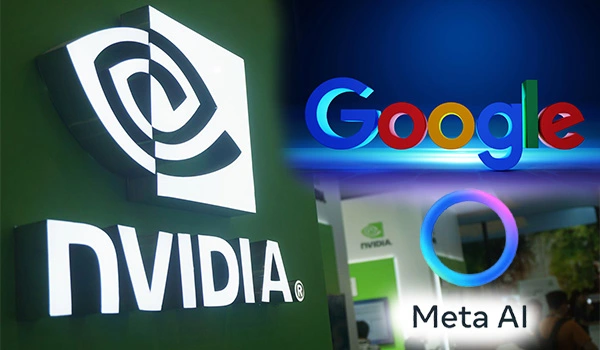
Google is reportedly preparing to collaborate with Meta in a strategic move aimed at reducing Nvidia’s dominance in artificial intelligence computing. According to Reuters, the partnership will focus on making Google’s Tensor Processing Units (TPUs) more compatible with Meta’s PyTorch framework, potentially reshaping the competitive landscape of AI hardware. The development highlights how the Google Meta AI partnership could open up new options for companies building and deploying large-scale AI models.
Why Google Needs Meta’s Support
Google’s TPUs are a critical driver of growth for its Cloud business, offering high-performance computing designed specifically for AI workloads. However, these chips are primarily optimised for Google’s in-house AI framework, JAX. In contrast, PyTorch—developed and open-sourced by Meta in 2016—has become the most widely used AI development framework globally.
The challenge for Google has been that PyTorch runs most efficiently on Nvidia’s Graphics Processing Units (GPUs), which dominate AI training and inference worldwide. This imbalance has discouraged many developers and enterprises from adopting TPUs. By strengthening PyTorch compatibility, the Google Meta AI partnership aims to remove this friction and make TPUs a more viable alternative.
Torch TPU and the Push Beyond Nvidia
Internally, Google’s initiative is known as “Torch TPU.” The project is designed to enable organisations to shift AI workloads from Nvidia GPUs to Google TPUs without extensive code rewrites or infrastructure changes. Reuters reports that Torch TPU is receiving increased internal focus, with Google even considering open-sourcing parts of the software to accelerate adoption.
Meta is expected to play a central role in this effort. The company is reportedly exploring TPU adoption through deals worth billions of dollars, making it a key collaborator rather than just a framework provider. This deep involvement strengthens the Google Meta AI partnership, benefiting both sides—Google gains broader TPU usage, while Meta reduces its reliance on Nvidia hardware.
Strategic Benefits for the AI Industry
A Google spokesperson confirmed to Reuters that the move is about giving customers more choice in AI computing. “Our focus is providing the flexibility and scale developers need, regardless of the hardware they choose to build on,” the spokesperson said. This philosophy aligns with the broader goals of the Google Meta AI partnership, which seeks to diversify the AI hardware ecosystem.
Google’s stance on TPUs has evolved in recent years. Previously reserved largely for internal use, TPUs were opened up to external customers in 2022 when Google Cloud took over sales and production oversight. Since then, the company has been actively trying to attract AI workloads from outside clients.
Nvidia’s Continued Dominance
Despite these efforts, Nvidia remains the undisputed leader in AI hardware. The company’s GPUs power most advanced AI models, supported by its CUDA software ecosystem. Last month, OpenAI signed a $38 billion deal with Amazon Web Services to access computing infrastructure largely driven by Nvidia GPUs. The AI boom has propelled Nvidia past a $4 trillion market capitalisation earlier this year.
Still, if successful, the Google Meta AI partnership could mark a meaningful step toward reducing the industry’s heavy dependence on a single AI chip supplier, introducing more competition and flexibility into the rapidly expanding AI computing market.
Browse our most recent publications