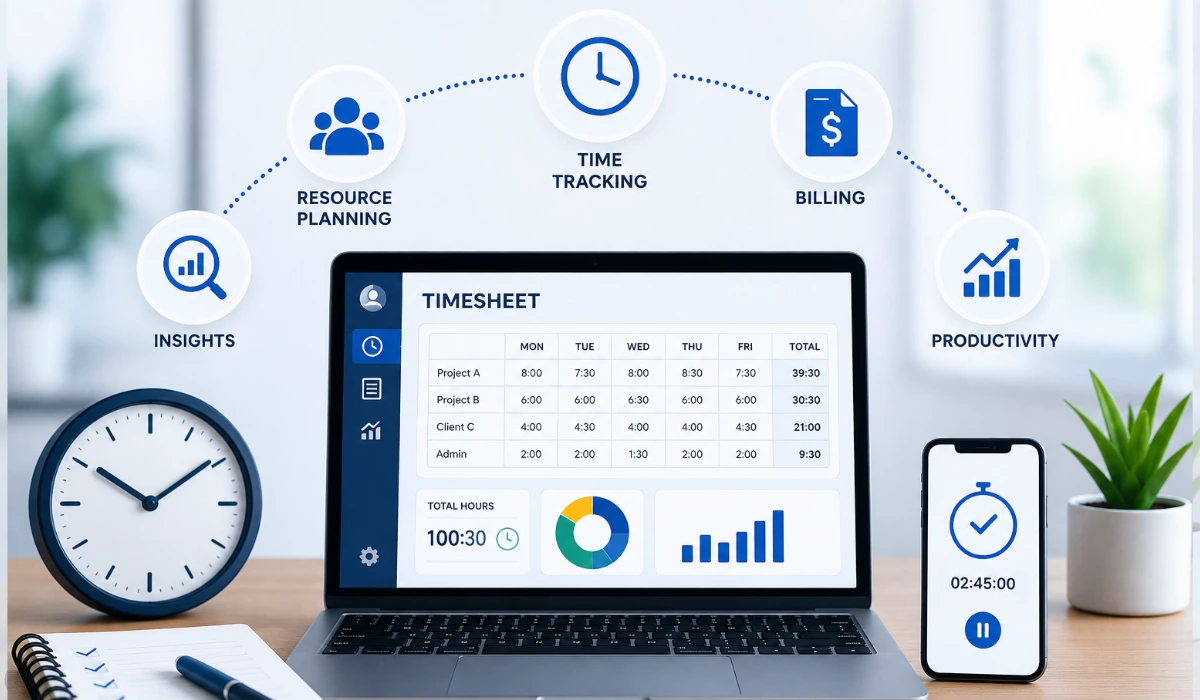
Why Timesheet Management Matters: Improving Workforce Visibility, Project Control, and Business Efficiency
Latest Updates






visionaries Network Team
18 July, 2026
it and software
Timesheet management has become an important component of modern workforce and project management. As organizations manage distributed teams, complex projects, multiple billing structures, and increasingly data-driven operations, accurately recording and analyzing employee time can provide valuable insight into how resources are being used.
Although timesheets are often associated with payroll, their role extends well beyond calculating working hours. Effective employee time tracking can support project costing, resource planning, billing, compliance, productivity analysis, and management decision-making.
What Is Timesheet Management?
Timesheet management is the process of recording, reviewing, approving, and analyzing the amount of time employees or contractors spend working on specific tasks, projects, clients, or activities.
Traditional timesheets were commonly completed manually, often using spreadsheets or paper forms. Modern timesheet management software can automate much of this process by allowing employees to record time digitally while managers review and approve entries through centralized systems.
The resulting data can provide organizations with a clearer picture of where working hours are being allocated and how those hours relate to operational and financial performance.
Why Is Timesheet Management Important?
1. Provides Greater Visibility Into How Time Is Spent
One of the primary benefits of timesheet management is improved visibility.
Organizations may know how many employees are working on a project, but without accurate time data, it can be difficult to determine how much effort individual tasks actually require.
Structured time tracking can help managers identify:
This information can support more informed operational decisions.
2. Improves Project Cost Management
Labor is a significant cost component for many organizations, particularly businesses operating in professional services, consulting, engineering, technology, construction, and project-based industries.
Project time tracking allows organizations to associate employee hours with specific projects and activities. When labor rates are applied to recorded hours, businesses can develop a clearer understanding of project costs.
Accurate time data can therefore help managers compare planned versus actual project effort and identify cost variances before they become larger problems.
3. Supports Accurate Client Billing
For organizations that bill clients according to hours worked, accurate timesheets are directly connected to revenue.
Consultants, contractors, law firms, technology companies, engineering firms, and other professional services organizations may use recorded hours as part of their billing processes.
Without reliable time records, businesses can face two opposing risks: underbilling, which can result in lost revenue, or inaccurate billing, which can create disputes and damage client relationships.
A structured timesheet process provides documentation showing how billable hours were allocated and approved.
4. Helps Improve Resource Planning
Resource management depends heavily on understanding how available capacity is being used.
Timesheet data can reveal how much time employees are spending across different projects and responsibilities. Over time, organizations can use historical information to improve estimates for future projects and identify potential resource shortages.
For example, if similar projects consistently require more engineering hours than originally estimated, historical timesheet data can help project managers create more realistic resource plans.
This makes timesheet management for project planning particularly valuable for organizations handling multiple concurrent projects.
5. Supports Payroll and Workforce Administration
Accurate time records can also support payroll processes, particularly for employees whose compensation depends on hours worked, overtime, shifts, or specific work arrangements.
Automated timesheet systems can reduce manual data entry and create standardized approval workflows. This can help organizations maintain more consistent records and reduce administrative effort.
However, payroll requirements vary by jurisdiction and employment arrangement, meaning organizations should ensure that their timekeeping practices comply with applicable employment and recordkeeping regulations.
6. Strengthens Project Performance Analysis
Timesheets can provide more than a record of working hours; they can become a source of project performance data.
By comparing estimated hours with actual hours, project managers can identify patterns such as:
These insights can contribute to better forecasting and project management practices.
7. Creates Better Management Data
Business decisions are increasingly influenced by operational data. Time represents one of the most important resources organizations manage, yet it can be difficult to measure without a structured tracking process.
Workforce time tracking creates a standardized dataset that can be analyzed alongside project, financial, payroll, and resource information.
When integrated with other enterprise systems, time data can provide a broader view of operational performance and help managers make decisions based on measurable information rather than assumptions.
Manual Timesheets vs. Automated Timesheet Management
Manual timesheets can still be suitable for smaller organizations with relatively straightforward workflows. However, as businesses grow, managing spreadsheets, emails, paper forms, and disconnected systems can become increasingly difficult.
Common challenges associated with manual processes include:
Automated timesheet management systems can centralize time entry, approval, reporting, and integration processes. Depending on the platform, they may also provide automated reminders, configurable workflows, dashboards, reporting, and connections with payroll, accounting, ERP, or project management systems.
The Role of Timesheet Management in Remote and Hybrid Work
The expansion of remote and hybrid working arrangements has increased the importance of consistent workforce processes.
When employees operate across different locations, teams may have fewer opportunities for informal visibility into workloads and project activity. A standardized time management process can provide structured information about how working hours are allocated.
Importantly, effective time tracking should focus on work allocation, project requirements, compliance, and organizational planning, rather than becoming an unnecessary mechanism for monitoring every individual activity.
Organizations should establish clear policies explaining what information is collected, why it is collected, and how it will be used.
Timesheet Management and Data Accuracy
The value of a timesheet system ultimately depends on the quality of the data being recorded.
Organizations can improve data accuracy by establishing clear categories for projects and activities, simplifying time-entry processes, setting defined submission schedules, and implementing appropriate approval procedures.
Automated reminders and validation rules can also help reduce incomplete or inconsistent entries.
The objective is not simply to collect more data. It is to create reliable time data that can support meaningful business decisions.
What Should Organizations Look for in Timesheet Management Software?
Businesses evaluating timesheet management solutions should consider their operational requirements rather than selecting a system solely on the basis of basic time-entry functionality.
Important considerations may include:
The right solution will depend on the organization's size, industry, workforce structure, project complexity, and regulatory requirements.
The Future of Timesheet Management
Technology is continuing to change how organizations collect and use workforce data. Cloud-based platforms, automation, analytics, and artificial intelligence are increasingly being incorporated into business management systems.
The future of timesheet management is likely to involve greater automation and integration, allowing time data to connect more closely with project management, workforce planning, financial systems, and business intelligence platforms.
Rather than functioning solely as a record of hours worked, timesheet data can become part of a broader operational information system.
Conclusion
Timesheet management plays a broader role in business operations than simply recording employee hours. Accurate and structured time data can help organizations understand resource utilization, manage project costs, support billing and payroll, improve forecasting, and make more informed workforce decisions.
As organizations become more distributed and project-driven, having reliable visibility into how time is allocated can become increasingly important. Whether managed through a basic process or an integrated timesheet management software platform, effective time tracking provides businesses with information that can support greater operational control and efficiency.
For organizations looking to improve project performance and resource planning, the key is not merely tracking time—it is turning accurate time data into actionable business insight.
FAQs About Timesheet Management
What is timesheet management?
Timesheet management is the process of recording, reviewing, approving, and analyzing employee or contractor working hours across projects, tasks, clients, or activities.
Why is timesheet management important for businesses?
It can improve visibility into resource utilization, support project cost management, facilitate accurate billing, assist workforce planning, and provide data for operational decision-making.
What is the difference between time tracking and timesheet management?
Time tracking focuses primarily on recording hours worked, while timesheet management encompasses the broader process of collecting, validating, approving, analyzing, and using that time data.
Who benefits from timesheet management software?
Project-based businesses, professional services organizations, consulting firms, technology companies, engineering organizations, and other businesses that need to manage employee time, project costs, billing, or resources can benefit from structured timesheet management.
Can timesheet management systems integrate with other business software?
Many modern platforms can integrate with systems such as payroll, accounting, ERP, project management, and workforce management platforms, although available integrations vary by provider.
Browse our most recent publications