Swiggy AI Strategy Boosts Efficiency, Drones Still Experimental
Latest Updates





visionaries Network Team
22 January, 2026
iot and robotics
Swiggy AI strategy expands across AI and robotics operations, improving customer service and partner insights as drone delivery stays in pilot mode
Indian food delivery platform Swiggy is aggressively scaling the use of artificial intelligence and robotics across its business, while drone-based food delivery continues to remain at an experimental stage. The insights were shared by Rohit Kapoor, CEO of Swiggy’s Food Marketplace, during the World Economic Forum Annual Meeting in Davos.
Swiggy AI Strategy Powers Daily Operations
Kapoor revealed that the Swiggy AI strategy now spans multiple layers of the organisation, from leadership decision-making to restaurant and delivery partners. Generative AI tools are being used to analyse operational data, improve service quality and enable faster responses across the platform.
According to Kapoor, AI has reached a level of maturity where it is no longer limited to specialists. “As AI expands into various aspects of life, it is providing democratised intelligence to all stakeholders,” he said, highlighting how widely the technology is being adopted within Swiggy.
Gen AI Enhances Customer Service and Insights
A key application of the Swiggy AI strategy lies in customer support. Generative AI can assess the quality of customer service calls in real time, allowing the company to identify issues instantly and take corrective action. This has significantly improved Swiggy’s ability to monitor service standards and customer satisfaction at scale.
Restaurant partners also benefit from AI-driven dashboards that track daily performance, showing which dishes are selling and which are underperforming. Delivery partners receive AI-powered inputs on demand trends and high-order zones, helping them optimise routes and maximise earnings.
Robotics Strengthen Warehousing and Supply Chain
Alongside AI, Swiggy is deploying robotics within its warehousing operations. Automation is being used to streamline sorting, storage and order preparation processes, improving efficiency and reducing turnaround time. Kapoor said these technologies are critical as the platform continues to scale across cities.
This combination of AI-led intelligence and robotics-driven automation forms the backbone of Swiggy’s operational transformation and long-term Swiggy AI strategy.
Drone Food Delivery Remains a Pilot Concept
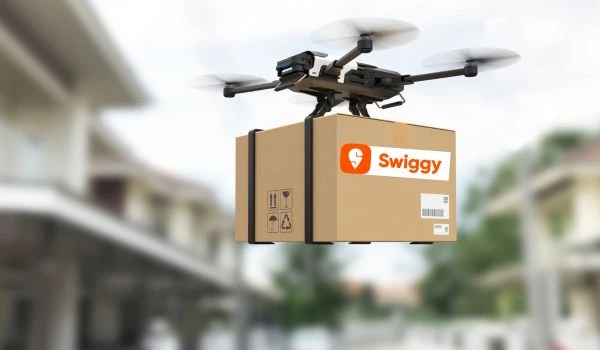
Despite advances in automation, Kapoor cautioned that drone-based food delivery has not yet moved beyond pilot stages. While experiments are underway in different regions, he said the use cases remain limited due to high costs and last-mile challenges.
Drones can deliver to fixed points but struggle with doorstep delivery in residential societies or office complexes. Unless costs decline significantly, adoption is likely to be slow. Still, Kapoor remains optimistic that evolving models could eventually change the landscape.
For now, Swiggy’s growth roadmap is firmly anchored in AI and robotics, with drone delivery staying on the fringes of its broader Swiggy AI strategy.
Browse our most recent publications