Terramera: Reinventing Crop Protection Through Clean Chemistry and Scalable Agricultural Innovation
Published: 2026-04-24 | Author: VisionariesNetwork Team
Modern agriculture faces a difficult balancing act. Farmers must protect crops from pests and disease while reducing reliance on synthetic chemicals that can harm ecosystems, impact human health, and face increasing regulatory scrutiny. For decades, the crop protection industry has struggled to find solutions that are both highly effective and environmentally responsible at scale. Terramera, a Canadian agtech company, is working to change that equation by rethinking how crop inputs are designed, delivered, and utilized.
Founded in Vancouver, Terramera operates at the intersection of plant science, chemistry, and data-driven technology. Its mission is not simply to replace conventional pesticides, but to make them better—cleaner, more efficient, and significantly less harmful. By combining advanced formulation techniques with artificial intelligence, the company aims to unlock the full potential of both natural and conventional active ingredients, creating solutions that deliver strong performance with a fraction of the environmental impact.
Rethinking Crop Protection at the Molecular Level
At the core of Terramera’s innovation is its proprietary technology platform, often referred to as Actigate. This system focuses on improving how active ingredients interact with plants and pests at the molecular level. Traditionally, many crop protection products are inefficient—only a small percentage of the applied chemical actually reaches and affects the intended target, while the rest is lost to the environment.
Terramera’s approach enhances the delivery and absorption of these ingredients, allowing them to work more effectively at much lower doses. By increasing bioavailability, the company enables farmers to achieve the same—or better—results using significantly reduced quantities of chemicals. This has major implications not only for environmental safety, but also for cost efficiency and regulatory compliance.
What makes this approach particularly compelling is its flexibility. The technology can be applied to both synthetic and naturally derived ingredients, opening the door to a new generation of hybrid solutions that combine the strengths of both. This versatility positions Terramera as a bridge between traditional agriculture and emerging biological alternatives.
Making Sustainable Solutions Scalable
One of the biggest challenges in sustainable agriculture is scalability. Many eco-friendly alternatives perform well in controlled conditions but struggle to match the consistency and reliability of conventional products in real-world farming. Terramera addresses this gap by focusing on performance as much as sustainability.
Its solutions are designed to integrate into existing agricultural systems without requiring major changes to equipment or practices. This ease of adoption is critical for farmers, who often operate under tight margins and cannot afford disruptions during the growing season. By delivering products that are both effective and practical, Terramera increases the likelihood of widespread adoption.
The economic case is equally important. Reducing the amount of active ingredient needed can lower input costs, while improved efficacy can lead to better crop outcomes. This alignment between sustainability and profitability is key to driving long-term change in the industry.
AI-Driven Innovation for Faster Discovery
In addition to its formulation technology, Terramera leverages artificial intelligence to accelerate the discovery and development of new crop protection solutions. The company uses machine learning models to analyze vast datasets, identifying patterns and predicting how different compounds will behave in agricultural environments.
This approach significantly reduces the time and cost associated with bringing new products to market. It also allows Terramera to explore a broader range of possibilities, including natural compounds that may have been overlooked using traditional methods. By combining AI with experimental science, the company is building a more efficient pipeline for innovation.
The integration of digital tools into agricultural chemistry reflects a broader trend across the industry. As data becomes increasingly central to decision-making, companies that can harness it effectively will be better positioned to develop solutions that are both targeted and adaptable.
Bridging the Gap Between Conventional and Regenerative Agriculture
Terramera’s work sits at a critical intersection in the evolution of agriculture. On one side is the conventional system, which relies heavily on synthetic inputs to ensure consistent yields. On the other is the growing movement toward regenerative and organic practices, which emphasize soil health, biodiversity, and reduced chemical use.
Rather than choosing one path over the other, Terramera is building a bridge between them. Its technology enables a gradual transition, allowing farmers to reduce their chemical footprint without sacrificing performance. This pragmatic approach recognizes the realities of modern farming while still pushing the industry toward more sustainable practices.
By improving the efficiency of existing inputs and unlocking the potential of natural alternatives, Terramera is helping to redefine what crop protection can look like. It’s not about eliminating tools, but about making them smarter, safer, and more aligned with the needs of both farmers and the environment.
As global agriculture continues to evolve, the demand for solutions that balance productivity with sustainability will only grow. Terramera’s integrated approach—combining chemistry, biology, and data—offers a glimpse into how that balance can be achieved at scale.4
CEO Spotlight
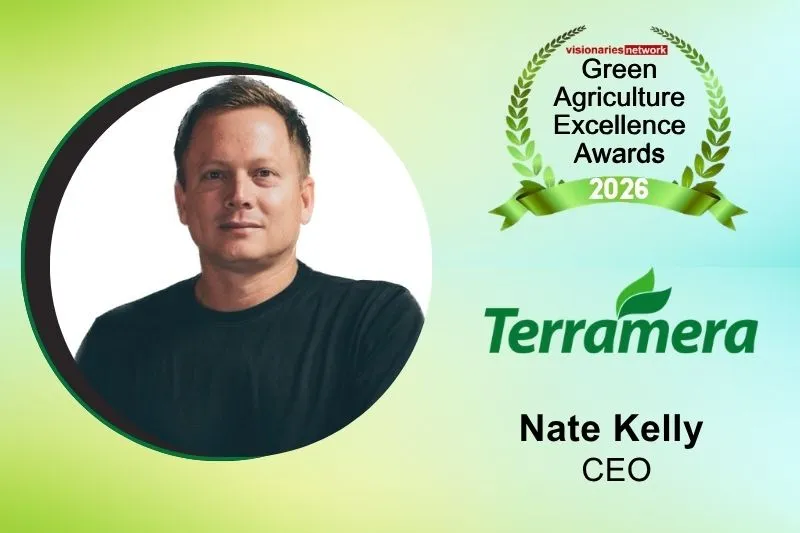
Nate Kelly, CEO: Nate leads Terramera by aligning vision, strategy, and execution, drawing on early experiences in agricultural communities across Colombia, the United States, and Canada. He brings over two decades of experience scaling technology companies and translating innovations from the lab into real-world applications. His background includes leadership roles at Tesla, Sonos, Microsoft, and Sony Ericsson, where he contributed to major industry transformations.
“The future of crop protection isn’t about choosing between performance and sustainability—it’s about redesigning solutions so that both work together, seamlessly and at scale.”
Browse our most recent publications