Ronak Desai, Founder and CEO of Ciroos, Is Transforming Enterprise Operations with AI
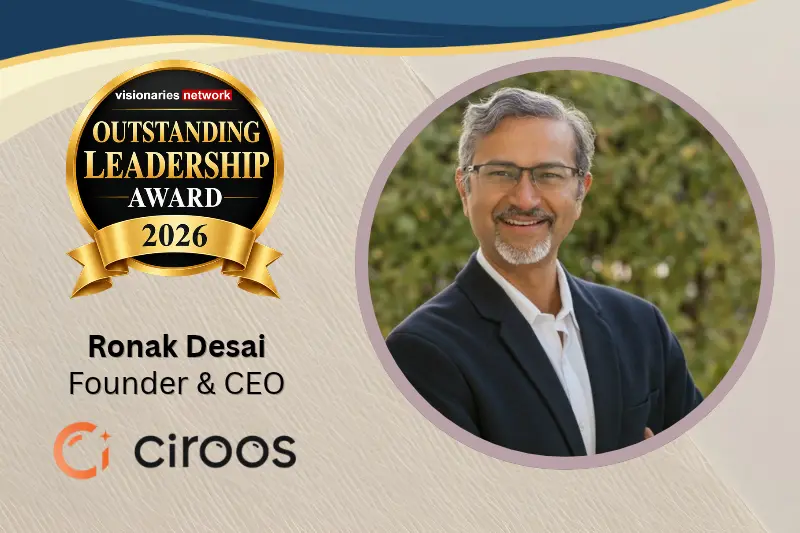
Published: 2026 | Author: VisionariesNetwork Team
Modern enterprises run on a complicated mix of applications, cloud infrastructure, networks, databases, third-party services, and constantly changing technology environments. When something goes wrong, finding the real cause is rarely as simple as looking at one dashboard. Engineers may have to move between different monitoring tools, examine alerts, check recent changes, trace dependencies, and bring together people from several teams before they understand what happened. Ciroos is taking a different approach to this challenge by bringing AI into the work of site reliability engineering (SRE) as an active teammate rather than another standalone tool.
Ciroos Brings a Broader View to Enterprise Technology Operations
Ciroos describes itself as an AI SRE solution built for enterprise complexity. Its platform is designed to help teams understand what actually happened and why across systems, teams, and technology domains. The company's focus is particularly relevant as enterprises continue to add more infrastructure and services while expecting their technology environments to remain available and reliable.
At the heart of the platform is the AI SRE Teammate, a multi-agent system designed to investigate operational issues using information from across an organisation's technology environment. Ciroos uses operational context such as dependencies, configuration, system changes, and historical behaviour to investigate incidents and identify potential root causes. Rather than limiting an investigation to one monitoring platform, it can trace problems across applications, infrastructure, cloud services, networks, and third-party dependencies.
Another important part of the company's platform is Ciroos Signal Intelligence™, which analyses cross-domain telemetry in real time. The goal is to move beyond simply grouping alerts and instead help teams understand the relationships between different signals. This approach is intended to reduce the investigative work that often consumes SRE time, particularly when an incident involves several systems at once.
Ciroos also takes a federated approach to enterprise environments. Instead of requiring organisations to replace or centralise their existing technology stack, the platform is designed to work across the tools and systems already in use. This allows Ciroos to reason across fragmented environments while allowing teams to maintain their existing operational processes.
The company's objective goes beyond faster incident response. Ciroos says it wants to help shift SRE work away from reactive firefighting and toward proactive engineering. By reducing investigative toil and expert bottlenecks, the company aims to help organisations increase operational capacity without simply adding more people to manage growing technology complexity.
Ciroos launched publicly with a $21 million funding round led by Energy Impact Partners, supported by prominent angel investors. The company positioned the investment around bringing agentic AI to modern enterprise operations and developing its AI SRE Teammate. Its founding team combines experience in infrastructure, observability, enterprise technology, and large-scale systems.
Ronak Desai Brings Enterprise Experience to the Reliability Challenge
Behind this focus is Ronak Desai, Founder and CEO of Ciroos, whose career has been closely connected to enterprise infrastructure and observability. Before Ciroos, Desai served as a Senior Vice President at Cisco, where he led AppDynamics and helped scale Cisco ACI into a business exceeding $5 billion, according to Ciroos. His experience gives him a direct understanding of the challenges organisations face when operating large and increasingly interconnected technology environments.
That background is important to the problem Ciroos set out to address. Desai has seen how much effort can go into maintaining reliable systems and investigating incidents when information is spread across different tools and teams. The company's founding premise grew from this experience: operations teams should have an intelligent partner that can help them investigate complex problems rather than simply giving them more dashboards or alerts to manage.
When Ciroos was announced, Desai described the company's motivation in terms of giving operations teams a teammate rather than another tool. The company's multi-agent architecture is intended to detect anomalies, correlate signals, and accelerate investigations while operating at machine speed.
Desai's thinking around AI and SRE also places considerable emphasis on the relationship between technology and human expertise. In a recent Ciroos discussion on reliability in the age of AI, he joined SRE leaders and technology experts to examine how AI can support operational decision-making. Ciroos's position is that AI should not simply replace engineering judgement. Instead, it can process large amounts of information, connect signals across domains, and remove repetitive investigative work, while people continue to define goals, establish reliability standards, and make important decisions.
This human-AI balance is also reflected in Desai's broader vision for Ciroos. The company describes automation, augmentation, and eventual autonomous operation as a continuum that should remain under human control. That perspective positions AI as a way of extending the capabilities of SRE teams rather than eliminating the expertise that makes those teams valuable.
For Desai, Ciroos brings together his experience in enterprise technology with a problem that has become increasingly difficult as systems grow more distributed. For the company, his background provides a practical foundation for developing technology around the realities of large-scale operations. As enterprises continue to depend on increasingly complex digital infrastructure, Ciroos is building toward a model in which AI can help engineers understand those environments more deeply, investigate incidents with greater context, and spend less time trapped in repetitive operational work.
“We built Ciroos to give SREs and operations teams an intelligent teammate that can reason through complex operational challenges and reduce the burden of constant firefighting.”
Frequently Asked Questions
1. Who is Ronak Desai?
Ronak Desai is the Founder and CEO of Ciroos, an enterprise technology company focused on applying agentic AI to site reliability engineering and IT operations. His experience includes building and scaling enterprise technology businesses and working with complex infrastructure environments.
2. What does Ciroos do?
Ciroos develops an AI SRE Teammate designed to help operations and SRE teams detect anomalies, correlate signals, investigate incidents, and identify potential root causes across complex technology environments.
3. What is Ronak Desai's contribution to Ciroos?
Desai has helped shape Ciroos around the idea that AI should work alongside SREs as a teammate rather than simply add another monitoring or observability tool. His enterprise technology background has informed the company's focus on reducing operational toil and improving the way teams investigate complex incidents.
4. How does Ciroos use agentic AI?
Ciroos uses a multi-agent architecture that can work across domains such as Kubernetes, cloud infrastructure, networking, and security. The system is designed to correlate information, detect patterns, and support autonomous or augmented resolution of operational issues.
5. What is Ronak Desai's vision for enterprise operations?
Desai and the Ciroos team are working toward enterprise systems that are reliable by design rather than dependent on constant reactive firefighting. Ciroos's stated mission is to build AI that can reason like an experienced SRE and help operations teams handle complex problems at scale.
Browse our most recent publications