
Kim Butler and Prosperity Thinkers: A New Approach to Financial Clarity, Cash Flow Mastery, and Lasting Wealth
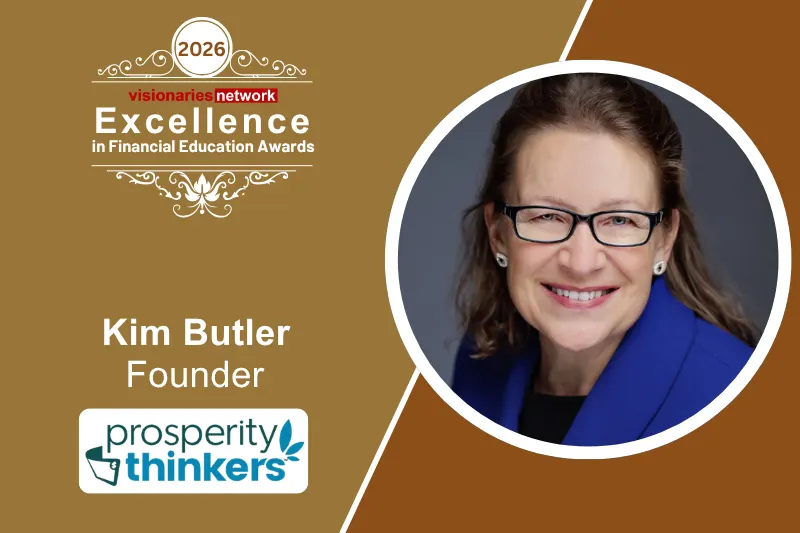
Published: 2026-07-07 | Author: VisionariesNetwork Team
In a world overflowing with financial advice, market predictions, and investment trends, finding clarity can be challenging. Many individuals and entrepreneurs work hard, follow conventional financial guidance, and accumulate assets, yet still feel uncertain about their financial future.
With more than three decades of experience in financial education, Kim Butler has made it her mission to help people simplify their financial lives. As the founder of Prosperity Thinkers, she encourages individuals and entrepreneurs to focus on what they can control—cash flow, protection, liquidity, and financial understanding—rather than becoming consumed by market uncertainty and future predictions.
By challenging typical assumptions and teaching timeless principles, Butler has helped countless families and business owners take greater ownership of their financial lives and create lasting prosperity on their own terms.
Redefining Financial Success Through Education
For much of her career, Butler has been driven by a simple observation: many people who appear financially successful still experience uncertainty about their future. They may have retirement accounts, investments, and valuable assets, yet they often lack the flexibility and confidence needed to respond to life's unexpected events.
That realization shaped her philosophy and ultimately became the foundation of her work with Prosperity Thinkers. Rather than measuring success solely by investment growth or net worth, Butler encourages people to focus on financial control, liquidity, and preparedness. She believes that wealth should provide freedom and options, not additional stress.
At Prosperity Thinkers, the mission is centered on helping individuals gain greater control over their money so they can make decisions from a position of confidence rather than fear. This perspective influences every aspect of Butler's work. Instead of emphasizing complicated financial products or market forecasts, she helps clients understand the principles that govern financial success.
Her educational approach is designed to simplify money rather than make it more complicated. Clients learn how cash flows through their lives, how to build stronger financial foundations, and how to create systems that support both short-term needs and long-term goals.
One of the reasons her message resonates so strongly is because it focuses on preparation rather than prediction. Butler often points out that life rarely follows a carefully designed financial plan. Economic conditions change, businesses evolve, opportunities emerge, and unexpected challenges arise. Rather than attempting to predict every future outcome, she teaches people how to build the flexibility needed to adapt.
From Scarcity Thinking to Prosperity Thinking
A central theme throughout Butler's work is the importance of mindset. She believes that financial success is influenced not only by strategy but also by how people think about money.
Many individuals operate from a scarcity mindset, focusing on limitations, sacrifice, and fear. Financial decisions are often driven by concerns about what might go wrong or what they cannot afford. Butler encourages clients to replace that perspective with what she calls prosperity thinking.
Prosperity thinking shifts the focus from limitation to possibility. Rather than asking what must be sacrificed, it asks how greater value can be created. Instead of concentrating on shortages, it focuses on opportunities, ownership, and stewardship.
This philosophy is especially relevant for entrepreneurs. Business owners understand that opportunities rarely appear according to a predictable schedule. Success often depends on having access to capital, flexibility in decision-making, and the confidence to act when opportunities arise.
Butler's emphasis on cash flow control aligns closely with this reality. She believes people should focus on strengthening their financial position so they can respond effectively to both opportunities and challenges. Having access to resources creates freedom, while a lack of liquidity can limit choices even when someone appears wealthy on paper.
Her willingness to challenge typical financial wisdom has also become one of her defining characteristics. She frequently encourages clients to question assumptions that are widely accepted within the financial industry.
For example, while budgeting is often promoted as the key to financial success, Butler argues that wealth is more commonly built through saving habits and cash flow management. Likewise, she encourages thoughtful discussions about debt, mortgage strategies, and retirement planning rather than accepting one-size-fits-all solutions.
Empowering Families Through Ownership and Control
Among Butler’s most influential teachings is the Family Banking Structure, a framework designed to help families take greater control of their financial resources. Built on the idea that every household already operates its own economy, the approach encourages people to manage money intentionally rather than by default.
Often supported by participating whole life insurance for its stability and accessibility, the strategy is less about the product and more about the mindset it creates.
Clients begin viewing money as a tool to be directed purposefully, leading to better decisions around saving, financing, and investing. As their understanding grows, they gain the confidence to take ownership of their financial future.
Through books, webinars, coaching programs, and other educational resources, Prosperity Thinkers helps individuals at every stage of their journey become more informed and empowered financial decision-makers.
A Vision for Generational Prosperity
Butler’s passion for financial education is deeply rooted in her upbringing on a dairy farm, where she learned the value of hard work, stewardship, and responsibility. Influenced by her educator parents and early experiences earning money through farm work, she developed a lifelong interest in learning and wealth-building principles.
After beginning her career in banking, she gained firsthand insight into the financial habits that shaped success and struggle, inspiring her to study economic history and timeless wealth strategies.
Today, through Prosperity Thinkers, Butler helps families and entrepreneurs build financial confidence and control. When she’s not teaching or writing, she and her husband Todd steward a herd of alpacas on their Texas farm. Her vision remains focused on empowering people to make financial decisions from a place of confidence, preparation, and prosperity while creating lasting impact for future generations.
Kim Butler: Helping Families Take Control of Their Financial Future
Kim Butler, founder of Prosperity Thinkers, has built her career around empowering people to make smarter financial decisions. For over 30 years, she has helped clients simplify savings, create sustainable asset-building systems, and develop lasting confidence in their finances. Through the organization's Pledge Membership and Prosperity Parents community, she continues to provide education and guidance that support greater financial control and long-term prosperity.
“Simplify savings, automate assets, and install faith in your finances.”
FAQs about Prosperity Thinkers
1. What is the core philosophy of Prosperity Thinkers?
It focuses on cash flow control, liquidity, and using money purposefully rather than relying on market-driven growth or predictions.
2. How does Prosperity Thinkers define financial success?
Success is measured by liquidity, capital access, debt efficiency, and financial flexibility—not just net worth or investment returns.
3. Why is liquidity emphasized in this framework?
Liquidity is treated as usable financial power, enabling individuals to act quickly on opportunities or handle disruptions without external borrowing.
4. What is the Family Banking Structure?
It is a system using dividend-paying whole life insurance to store capital and reuse it through policy loans while the cash value continues to grow.
5. What is the critique of typical financial planning?
It argues that most financial l models rely too heavily on forecasts and market performance, often ignoring volatility, taxes, fees, opportunity costs, and the need for adaptable financial systems.
Browse our most recent publications