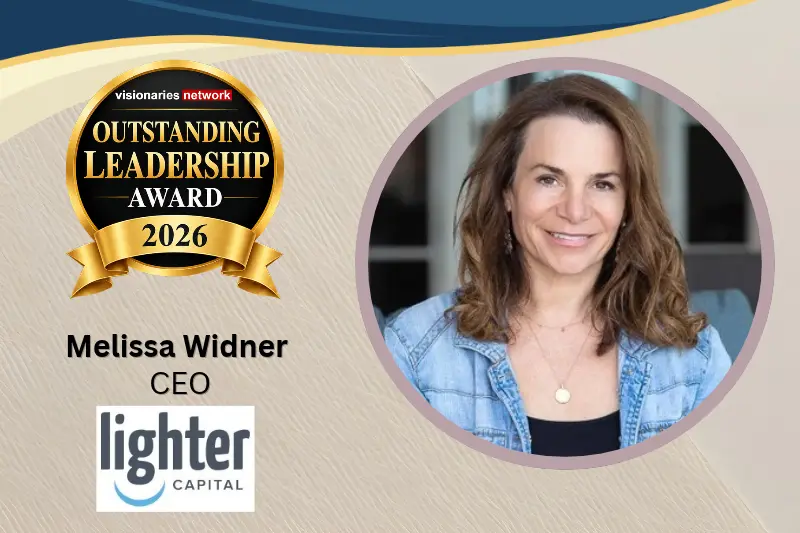
Melissa Widner, CEO of Lighter Capital, Is Expanding Access to Founder-Friendly Growth Capital
Published: 2026 | Author: VisionariesNetwork Team
For many technology founders, raising capital comes with a difficult calculation. Equity funding can provide the resources needed to expand, but it can also mean giving up part of the ownership and control built through years of work. Traditional debt, meanwhile, may bring repayment structures that do not always match the realities of a growing technology business. It is within this gap that Melissa Widner and Lighter Capital have built their work, offering an alternative approach to financing that is designed around a company’s revenue and growth trajectory.
Widner brings a background that combines entrepreneurship, venture investing, and leadership across the technology ecosystem. She became CEO of Lighter Capital in September 2020, bringing with her experience from both sides of the startup funding equation. Before joining Lighter Capital, she was Managing Director of NAB Ventures, the venture capital arm of National Australia Bank, and previously served as a general partner at U.S.-based Seapoint Ventures. Lighter Capital notes that Widner has also led two companies to successful exits that generated more than a 10x return for investors.
Her experience as an investor and operator gives her a practical understanding of the decisions founders face when looking for capital. Rather than treating financing as simply a transaction, Widner has consistently emphasized the importance of giving entrepreneurs room to make decisions about their companies. In her leadership at Lighter Capital, that thinking is reflected in the company's focus on non-dilutive financing and its broader founder community.
Widner is also connected to initiatives supporting women entrepreneurs. She co-founded Heads Over Heels, an Australian organization focused on helping women leading high-growth companies access strategic networks and connections. She has served as its chairperson, reflecting another dimension of her work around entrepreneurship and access to opportunities.
Turning Revenue into a More Flexible Source of Growth Capital
Lighter Capital was founded in 2010 around a straightforward idea: startups with recurring revenue should have funding options that do not necessarily require them to sell part of their business. Today, the company describes itself as a provider of non-dilutive financing for technology and SaaS companies, combining capital with a network and support resources for founders.
Its core offering is revenue-based financing. Instead of taking an ownership stake, Lighter Capital provides upfront capital and structures repayment around a percentage of the company's monthly revenue. When revenue grows, payments can increase, allowing the financing to be paid back more quickly. When revenue is lower, payments can decrease accordingly. The company also provides term-based financing with fixed monthly payments and contract-based financing for businesses with longer-term contracts.
This model is particularly relevant to SaaS and subscription businesses, where recurring revenue can provide a measurable basis for financing. Lighter Capital says companies seeking funding generally need at least $200,000 in annual recurring revenue, serve a reasonably diverse customer base, and be headquartered, or have a branch or subsidiary, in the United States, Canada, or Australia.
The company's financing can be used across different areas of growth. Founders can use capital for working capital, sales and marketing, product development, hiring, market expansion, infrastructure, or to bridge an equity round. The objective is not to dictate how a founder should grow the company, but to provide capital that can be deployed according to the business's needs.
More Than Financing for Technology Founders
One of the more distinctive aspects of Lighter Capital's model is that the relationship does not end when the funding is provided. The company has developed a founder community that gives portfolio CEOs opportunities to connect, share experiences, and access resources.
Lighter Capital currently says its community includes more than 150 startup leaders. Its broader offering includes networking opportunities, founder events, connections to potential capital partners, and product and service discounts. The company positions these resources as a complement to its financing, giving founders access to some of the relationship-based support they might otherwise associate with equity investors.
The Lighter Summit is one example of this approach. The company has brought founders and CEOs from its portfolio together for discussions around subjects such as acquisitions, fundraising, board management, company culture, and preparing for an exit. Widner has participated in and moderated several of these conversations, placing her directly in dialogue with entrepreneurs navigating similar growth challenges.
That emphasis on community also reflects Widner's own approach to leadership. In one of her reflections as CEO, she wrote about the importance of helping employees develop even when their ambitions may eventually take them elsewhere. Her comments pointed toward a leadership style centered on mentorship, openness, and creating opportunities for people to grow.
Expanding the Reach of Non-Dilutive Capital
Lighter Capital has continued expanding its ability to fund technology businesses as demand for alternatives to traditional venture capital has evolved. In 2023, the company announced $130 million in new funding facilities, including $100 million for the United States and Canada and $30 million for Australia. The capital was intended to support additional financing for early-stage technology companies.
The company's Australian presence has also become an important part of its expansion. In 2024, Lighter Capital said it had doubled the value of its Australian portfolio, while a later $30 million facility supported further investment in Australian technology startups.
The company's scale has grown considerably since its early years. Lighter Capital now reports more than $550 million in non-dilutive funding deployed and more than 660 startups funded. It also says its team spans four continents and that it has built a community of more than 150 startup leaders.
For founders, the significance of this model lies in the additional choice it creates. A company does not necessarily have to view fundraising as a decision between selling equity and taking on conventional debt. Revenue-based financing introduces another structure, one that can be aligned more closely with recurring revenue and the pace of a growing business.
A Founder-Centered Approach to the Next Stage of Growth
Under Widner’s leadership, Lighter Capital continues to provide growth financing for technology and SaaS companies that want to expand without giving up equity. Her experience across startups, venture capital, and company building complements the company’s founder-focused approach. By combining non-dilutive financing with networking and business resources, Lighter Capital gives entrepreneurs more flexibility as they scale while keeping ownership and decision-making in their hands.
“Growth capital should give founders room to build, not force them to give up the ownership they worked hard to create.”
FAQs
1. What is Melissa Widner known for?
Melissa Widner is known for her work as an entrepreneur, investor, and technology leader. She is the CEO of Lighter Capital and has spent much of her career working with growing technology companies.
2. What kind of companies does Lighter Capital finance?
Lighter Capital mainly works with technology and SaaS companies that have established revenue. Its financing is intended to help these businesses fund their next stage of growth.
3. Does Lighter Capital take equity in the companies it funds?
No. Lighter Capital’s financing is non-dilutive, meaning founders do not have to give up ownership of their company in exchange for the funding.
4. What can companies use Lighter Capital funding for?
Companies can use the funding for areas such as hiring, sales and marketing, product development, working capital, and expansion.
5. What makes Lighter Capital’s approach different?
Lighter Capital ties some financing repayments to a company’s revenue rather than taking an ownership stake. It also provides founders with networking opportunities and other resources alongside its financing.
Browse our most recent publications