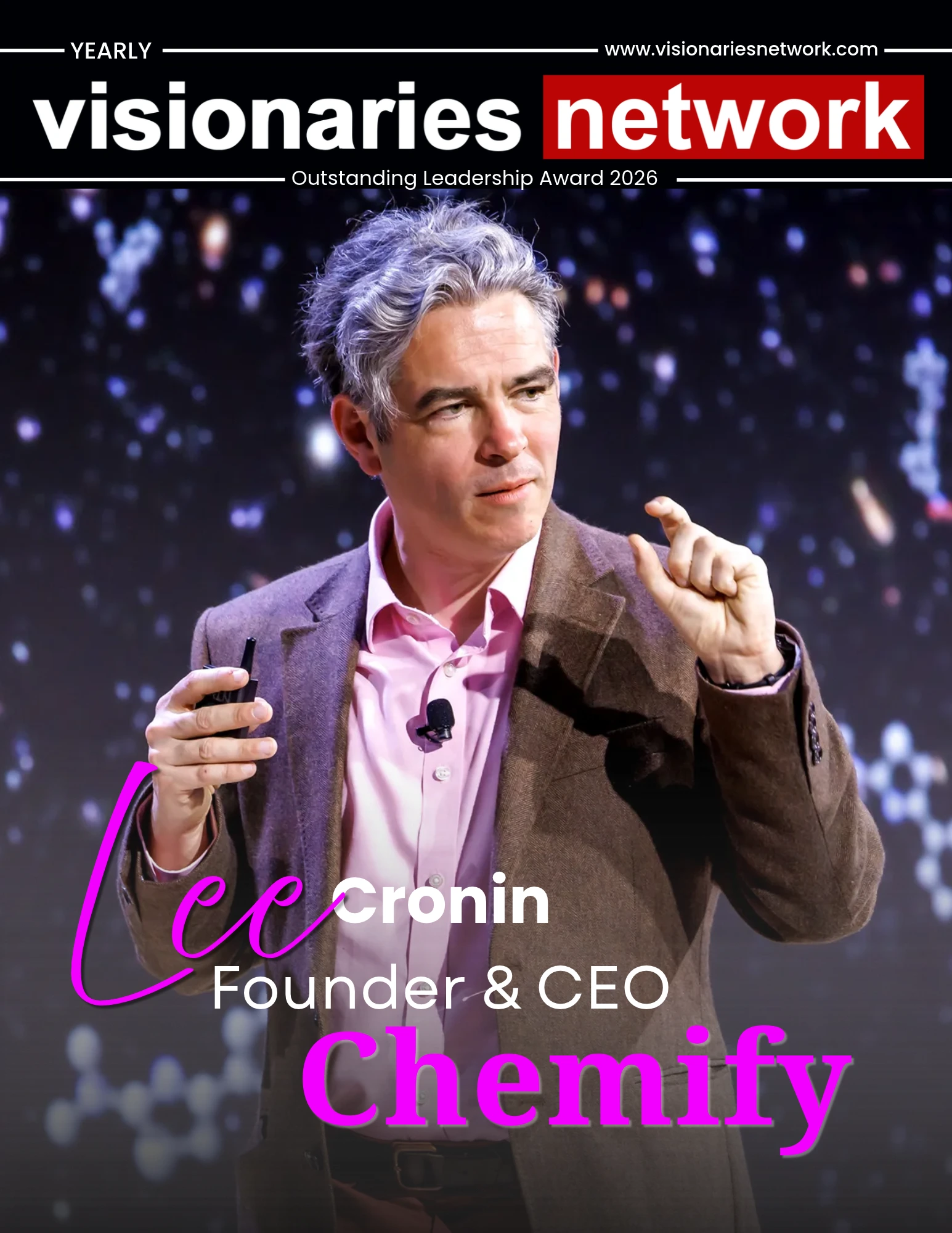
Lee Cronin, CEO and Founder, Is Bringing a Digital Approach to Chemistry Through Chemify
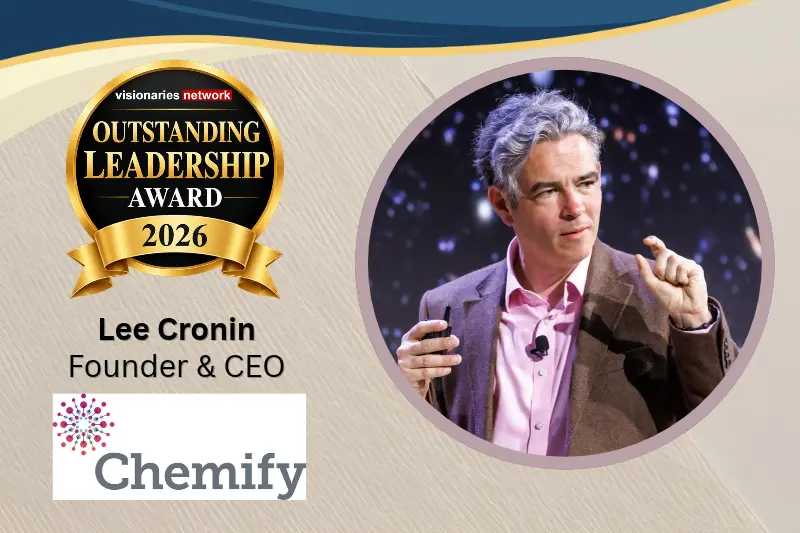
Published: 2026 | Author: VisionariesNetwork Team
Chemistry has always depended on a combination of scientific knowledge, practical experience, and extensive laboratory work. Even with advances in computing and artificial intelligence, turning a promising molecular idea into a physical compound can still require many rounds of experiments. Chemify is working to change that process by connecting computational design with automated chemistry. Founded by Professor Lee Cronin in 2022, the Scotland-based company is developing a digital foundation for designing and making molecules.
Turning Chemical Ideas into Programmable Processes
At the heart of Chemify's work is Chemputation, an approach that brings together machine learning, chemical programming, and robotics. The company's technology is designed to take a target molecule, determine how it could be made, translate the process into chemical code, and then execute the synthesis through automated laboratory equipment. This creates a connection between the digital side of molecular discovery and the physical work traditionally carried out by chemists in laboratories.
A key part of this system is Chemify's chemical programming language, χDL. It provides a standardized way of describing chemical procedures so that they can be translated into instructions for automated systems. The company's ASSEMBLER software works alongside this technology to identify synthetic routes using a database of reactions that have been validated and optimized for automated execution. The intention is to make chemical procedures more reproducible while reducing some of the trial and error involved in conventional synthesis.
Connecting Molecular Design with Automated Synthesis
Chemify's approach does not stop at writing chemical instructions. Its technology brings molecular design, synthesis, purification, and analysis into a connected workflow. Through its Quantum Chemputation process, the company combines quantum mechanics, inverse design, and Chemputation to consider whether proposed molecules can actually be produced. That focus on synthesis-aware design is important because a molecule that looks promising computationally is of limited practical use if it cannot be made efficiently.
The company is also developing automated systems that can handle different stages of chemical work, including reaction optimization, synthesis, workup, purification, and analytical assessment. Data collected during these processes can then be used to improve future experiments. Chemify says its systems monitor factors such as reagents, catalysts, temperature, pressure, and yield, creating a feedback loop that can support continued optimization.
From University Research to a Growing Technology Company
The foundations of Chemify come from more than two decades of research conducted by the Cronin Group at the University of Glasgow. According to Chemify, that research has produced more than 500 papers, with significant work focused on digitizing, programming, and automating chemistry. The company was established to take those ideas beyond the academic laboratory and develop them into practical technology for molecular discovery and synthesis.
Chemify has since expanded its operations and opened its first Chemifarm in Maryhill, Glasgow, in 2025. The facility provides an environment in which the company's digital chemistry systems can be connected with automated synthesis. Chemify now has more than 200 employees, with more than half holding advanced degrees in chemistry or engineering, reflecting the combination of scientific and engineering expertise required for its approach.
Lee Cronin and the Research Behind the Vision
The person behind this transformation is Lee Cronin, PhD, Founder and CEO of Chemify and Regius Chair of Chemistry at the University of Glasgow. His career has been closely linked to exploring how chemistry can be understood and manipulated through new forms of computation, automation, and molecular design.
Cronin earned his PhD in Chemistry from the University of York and went on to establish a research career that crossed traditional boundaries within chemistry. At Glasgow, his research group has investigated complex chemical systems and developed technologies aimed at making chemical synthesis increasingly programmable. His work has included the development of the Chemputer, an automated chemical computer system designed to execute chemical synthesis from digital instructions.
A Long-Term Interest in Programmable Chemistry
Cronin's interest in programmable chemistry did not begin with Chemify. His academic research has spent years exploring the idea that chemical procedures could be represented digitally, transferred between systems, and executed with greater consistency. One notable research project demonstrated the automated synthesis of several pharmaceutical compounds using a Chemputer system, showing how chemical procedures could be encoded and executed without conventional manual intervention.
That research provides an important link between Cronin's academic work and the technology now being developed by Chemify. Rather than treating automation simply as a way to replace repetitive laboratory tasks, his work has explored how software, robotics, and chemical knowledge can operate together as a new type of scientific infrastructure.
Bridging Chemistry, Computing, and Robotics
Cronin's position at the University of Glasgow has also allowed him to continue developing the scientific foundations behind this work. The Digital Chemistry group associated with his research has continued publishing on areas including Chemputation, chemical programming, machine learning, and automated experimentation. A recent research collaboration involving the group has explored the use of AI and Chemputation for large-scale materials discovery, demonstrating how these tools can be applied beyond conventional drug-development workflows.
For Cronin, the broader opportunity lies in changing how scientists interact with chemical space. Traditional chemistry can require researchers to work through individual experiments, while a programmable approach offers the possibility of describing procedures digitally, automating their execution, and using the resulting data to guide subsequent experiments. This creates a more connected cycle between computation and laboratory science.
Making Chemistry More Accessible Through Technology
Cronin's role at Chemify brings together the two sides of his career: long-term academic research and the development of technology designed for real-world use. Chemify is now applying the principles developed through the Cronin Group to challenges involving medicines, materials, and molecular discovery. Its model is built around the idea that researchers should be able to move more directly from a desired molecular structure to a practical route for making it.
As Chemify continues to develop its technology, the company is pursuing a broader vision of chemistry in which digital design and physical synthesis are closely connected. For Lee Cronin, the journey from academic research to entrepreneurship has provided a way to turn years of work in programmable chemistry into a platform with applications across scientific discovery. Chemify's progress reflects that continuing effort to make molecule creation more systematic, automated, and accessible through the combination of chemistry, computation, AI, and robotics.
“We connect the digital world of molecular design with the physical reality of chemical synthesis.”
Frequently Asked Questions
1. What is Chemify's Chemputation technology?
Chemputation is Chemify's approach to combining chemistry with software, machine learning, and automated laboratory systems. It is designed to connect molecular design, chemical synthesis, and analysis within a digital workflow.
2. Who founded Chemify?
Chemify was founded by Lee Cronin, PhD, who serves as the company's CEO and Founder. He is also the Regius Chair of Chemistry at the University of Glasgow.
3. What is χDL used for in Chemify's technology?
χDL is Chemify's chemical programming language. It provides a way to represent chemical procedures digitally so they can be translated into instructions for automated laboratory systems.
4. What is the Chemputer developed by Lee Cronin's research group?
The Chemputer is an automated chemical system developed through research led by Lee Cronin and his group. It is designed to execute chemical synthesis using digitally defined procedures, linking software instructions with physical laboratory equipment.
5. What areas is Chemify's technology intended to support?
Chemify's technology is being developed for applications including drug discovery, molecular research, and materials discovery, with the broader goal of making the design and production of molecules more systematic and automated.
Browse our most recent publications