
Inside MATRiX ANALYTiCS: Where Financial Expertise Meets Intelligent Innovation
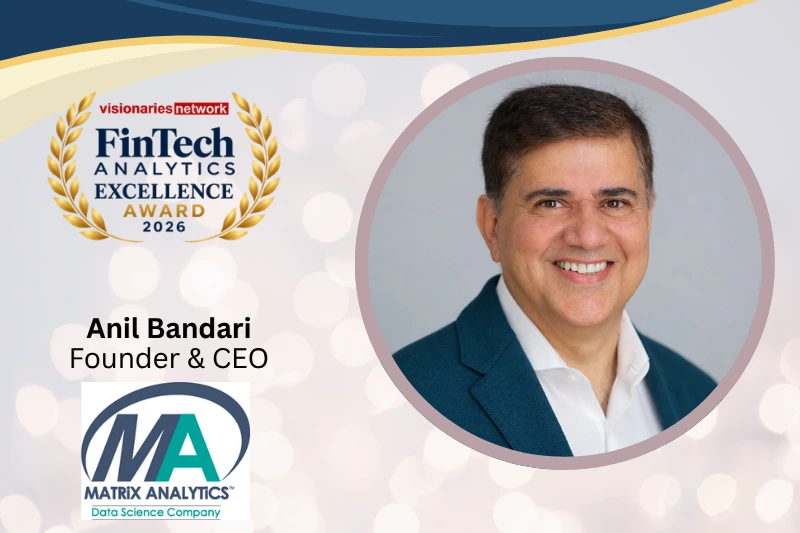
Published: 2026-09-21 | Author: VisionariesNetwork Team
Financial institutions today are surrounded by data. Every transaction, credit interaction, customer relationship, and portfolio movement generates information that could support better decisions. Yet having more data does not necessarily make those decisions easier. When information is fragmented across systems, difficult to interpret, or disconnected from business objectives, its value can remain largely untapped.
This is where MATRiX ANALYTiCS CORPORATION brings a different perspective. Combining financial-services expertise with advanced analytics and AI, the company helps banks and fintech organizations turn complex data into actionable insight. From lending and credit risk to fraud, pricing, portfolio management, and customer engagement, MATRiX focuses on helping institutions make decisions that are not only more informed, but also practical, explainable, and aligned with the realities of modern financial services.
Where Financial Expertise Meets Intelligent Data
MATRiX was not created simply because AI became popular. Its foundation comes from years of experience across financial services, including credit risk, customer behavior, pricing, portfolio performance, technology, and regulatory requirements. That experience highlighted a common challenge: financial institutions may have extensive information, but turning it into useful answers is not always straightforward.
Information can sit across multiple systems, while teams may view the same customer or risk from different perspectives. Even when an analytical model produces an answer, it may not always be clear how that conclusion was reached. Regulatory expectations add another layer of complexity.
MATRiX was built to address these challenges. The company begins with what an institution wants to achieve and identifies where analytics can create value. Its solutions are shaped around each client's data environment, business model, risk approach, and regulatory requirements, allowing technology to support the business rather than forcing the business to adapt around it.
Turning Insight Into Financial Action
MATRiX works across several areas of financial services, supporting customer acquisition, credit underwriting, risk-based pricing, fraud detection, portfolio management, early-warning systems, collections, and customer engagement.
In lending, for example, analytics can bring together different signals to give decision-makers a broader view of potential risk rather than relying on a single number. In portfolio management, identifying changes in customer behavior early can give institutions more time to respond. In fraud detection, analytical tools can uncover unusual patterns across large volumes of transactions.
The same capabilities can also help institutions better understand customer needs and develop more relevant products and services.
For MATRiX, the work does not end when a model is built. The company also considers how models are used, monitored, tested, and governed. This matters because financial decisions can directly affect people. A lending model can influence access to credit, while a fraud system can protect an account but also inconvenience a legitimate customer if it produces an incorrect alert.
Effective analytics therefore needs to deliver business value while remaining reliable and responsible in real-world applications.
Putting AI to Work With Purpose
AI is changing financial services, but MATRiX takes a practical view of where and how it should be applied. Generative AI, real-time analytics, alternative data, automated processes, and personalized financial services are creating new possibilities for banks and fintech companies.
The next stage could involve systems that do more than predict outcomes. They may interpret information, recommend what should happen next, and eventually perform certain tasks within boundaries established by the organization.
That does not mean every financial decision should be handed over to a machine. Institutions need to understand how significant decisions are made and whether the information behind a model is reliable. MATRiX therefore considers explainability, privacy, fairness, cybersecurity, model validation, and human oversight when working with AI.
The company also helps clients evaluate generative and agentic AI when there is a clear business case. The question is not simply whether a technology is new, but whether it can improve a specific business function and whether its risks can be responsibly managed.
Bringing Innovation Into the Systems Banks Already Use
For many financial institutions, adopting new technology is not as simple as installing new software. Banks and fintech companies often operate with systems developed over many years, with established processes connecting multiple departments. Replacing everything at once is rarely practical.
MATRiX takes these realities into account when developing and implementing its solutions. The company examines existing systems, business processes, information environments, and governance requirements before developing solutions designed to work within them.
Its approach considers data lineage, governance, privacy, compliance, testing, and cybersecurity from the outset.
Collaboration across teams is also important. Business teams understand the problem, technology teams understand the systems, risk teams assess exposure, and compliance and governance teams understand the requirements. Bringing these perspectives together helps ensure that a technically sound solution can also work in practice.
MATRiX takes a phased approach to implementation, allowing solutions to be tested, measured, refined, and monitored as they move into wider operations. Continued monitoring is important because financial markets, customer behavior, and business conditions change over time.
A Long-Term View of Financial Analytics
Building the Future of Smarter Financial Services. The company's approach is closely connected to its leadership philosophy. MATRiX places importance on clear goals, honest discussion, preparation, and disciplined execution. Its teams are encouraged to question assumptions and look for better answers while balancing experimentation with responsibility.
The leadership journey behind MATRiX has crossed financial services, credit risk, analytics, technology, and entrepreneurship. This experience provided a close view of the gap between what data can potentially tell an institution and what organizations can realistically use in everyday decision-making.
Experience in building and leading diversified companies within AriMAx Group also brought an understanding of what it takes to move an idea from planning into an operating business.
That experience continues to shape MATRiX's direction. The company aims to help financial institutions derive greater value from their information while preparing them for the growing role of AI. Its focus remains on practical questions: Can a decision be improved? Can a risk be identified earlier? Can a customer be served more appropriately? Can technology be adopted without losing sight of accountability?
As financial services become increasingly dependent on analytics, AI, and automated systems, these questions will become even more important. MATRiX ANALYTiCS CORPORATION is positioning itself around that challenge, bringing together analytics, AI, and financial expertise to help institutions turn complex information into meaningful insight and practical action.
Anil Bandari, Founder and CEO
Anil Bhandari brings extensive experience in financial services, risk analytics, and data science to his role as CEO of MATRiX ANALYTiCS CORPORATION. Before founding MATRiX, he led Global Modeling and Risk Analytics at Citi across seven major markets: Australia, Singapore, Hong Kong, India, Malaysia, Thailand, and Vietnam. He also served as a Director in Global Credit & Fraud Risk Management in New York.
Over the course of his career, Anil has worked across data science, artificial intelligence, transaction analytics, data warehousing, signal processing, credit and fraud risk modeling, profit optimization, and customer analytics. At MATRiX, he is using this experience to help financial institutions make better use of data and analytics.
“Better data is not about having more information. It is about making better decisions with the information already available.”
Frequently Asked Questions
1. What makes MATRiX ANALYTiCS different from other financial analytics companies?
MATRiX combines financial-services expertise with analytics and AI, developing solutions around real business, risk, and regulatory challenges.
2. How does MATRiX help financial institutions make better decisions?
It turns complex information into actionable insights across lending, risk, fraud, pricing, portfolio management, and customer engagement.
3. How does MATRiX approach AI in financial services?
MATRiX focuses on practical AI applications while prioritizing explainability, privacy, fairness, cybersecurity, validation, and human oversight.
4. Can MATRiX work with existing banking systems?
Yes. Its solutions are designed to work within existing technology environments, supporting phased implementation rather than requiring institutions to replace their systems.
5. Which financial services can benefit from MATRiX's solutions?
Its capabilities can support credit underwriting, fraud detection, risk-based pricing, portfolio management, collections, customer acquisition, and customer engagement.
Browse our most recent publications