
Freight Farms is Transforming Urban Agriculture with Smart Container Farming and Year-Round Local Food Production
Published: 2026-04-24 | Author: VisionariesNetwork Team
As cities expand and supply chains grow increasingly complex, the question of how to produce fresh, reliable food closer to where people live has become more urgent. Traditional agriculture, while essential, is often constrained by geography, climate, and logistics. Freight Farms, a U.S.-based agritech company, is tackling this challenge with a model that brings farming directly into urban environments—using technology, data, and a surprisingly simple unit: the shipping container.
Founded in Boston, Freight Farms set out with a bold idea—to make it possible for anyone, anywhere, to grow fresh food year-round. By transforming standard freight containers into fully controlled hydroponic farms, the company has created a system that decouples food production from traditional limitations like weather, soil quality, and land availability. The result is a scalable, flexible approach to agriculture that fits as easily in a city parking lot as it does on a rural property.
Farming Without Borders: The Container Revolution
At the heart of Freight Farms’ offering is the “Greenery” container farm, a self-contained growing system equipped with LED lighting, climate controls, and hydroponic technology. Inside each unit, crops are grown vertically, maximizing space and enabling high-density production within a compact footprint.
This controlled environment allows farmers to grow leafy greens, herbs, and other crops consistently throughout the year, regardless of external conditions. Temperature, humidity, light, and nutrient delivery are all precisely managed, ensuring optimal growing conditions at all times.
What makes this model particularly compelling is its portability and ease of deployment. Because the farms are built within shipping containers, they can be installed in a wide variety of locations with minimal infrastructure. This opens up new possibilities for food production in areas where traditional farming would be impractical or impossible.
Technology-Driven Simplicity and Control
Freight Farms combines hardware with a robust software platform that gives users full control over their farm from virtually anywhere. Through its proprietary operating system, farmers can monitor and adjust growing conditions, track plant health, and receive alerts in real time.
This integration of technology simplifies what might otherwise be a complex process. Even individuals without traditional farming backgrounds can learn to operate the system effectively, supported by Freight Farms’ training programs and customer resources. The company has built a strong emphasis on accessibility, lowering the barrier to entry for aspiring urban farmers, educators, and entrepreneurs.
Data plays a central role in this ecosystem. By collecting and analyzing growing data, users can refine their practices over time, improving yields and consistency. This feedback loop transforms farming from a largely experience-based activity into a more precise, repeatable process.
Strengthening Local Food Systems
One of the most significant advantages of Freight Farms’ model is its impact on local food systems. By enabling food production within or near urban centers, the company helps reduce reliance on long, often fragile supply chains. This can lead to fresher produce, lower transportation costs, and reduced carbon emissions.
The local nature of container farming also creates opportunities for community engagement. Schools, restaurants, nonprofits, and small businesses can all participate in food production, fostering a closer connection between people and the food they consume. In some cases, Freight Farms’ systems are used as educational tools, teaching students about agriculture, sustainability, and technology in a hands-on way.
In regions where access to fresh produce is limited, this approach can play a role in improving food security. By bringing production closer to consumption, communities can gain greater control over their food supply and reduce vulnerability to external disruptions.
Building a New Model for Sustainable Agriculture
Freight Farms is part of a broader movement toward controlled environment agriculture (CEA), which is gaining traction as a complement to traditional farming. While it may not replace large-scale field agriculture, it offers a valuable alternative for specific crops and contexts—particularly where space, climate, or logistics pose challenges.
The company’s focus on efficiency extends beyond space utilization. Hydroponic systems typically use significantly less water than conventional farming, and the controlled environment reduces the need for pesticides. These factors contribute to a more sustainable production model, aligning with growing demand for environmentally responsible food systems.
As the global population continues to urbanize, the need for innovative approaches to food production will only increase. Freight Farms’ container-based model provides a glimpse into how agriculture can adapt—becoming more distributed, technology-driven, and resilient.
By combining practical design with advanced technology, Freight Farms has created more than just a product—it has built a platform for rethinking where and how food is grown. In doing so, it is helping to reshape the relationship between cities and agriculture, making fresh, local food more accessible in an increasingly complex world.
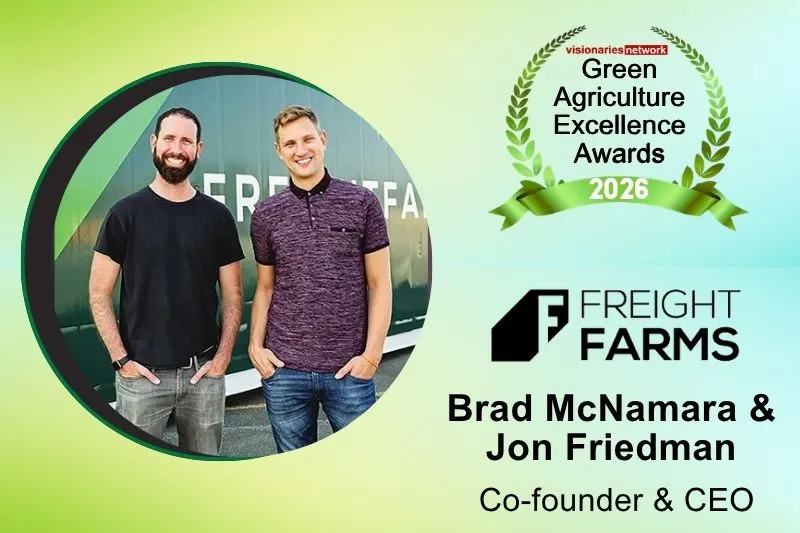
Brad McNamara and Jon Friedman, Co-founders
“The future of farming isn’t confined to fields—it’s about bringing food production closer to people, wherever they are, and making it smarter, more local, and more resilient.”
Browse our most recent publications