Smart Factories Are Moving from Concept to Commercial Reality
Latest Updates



visionaries Network Team
28 September, 2026
ai vr and automation
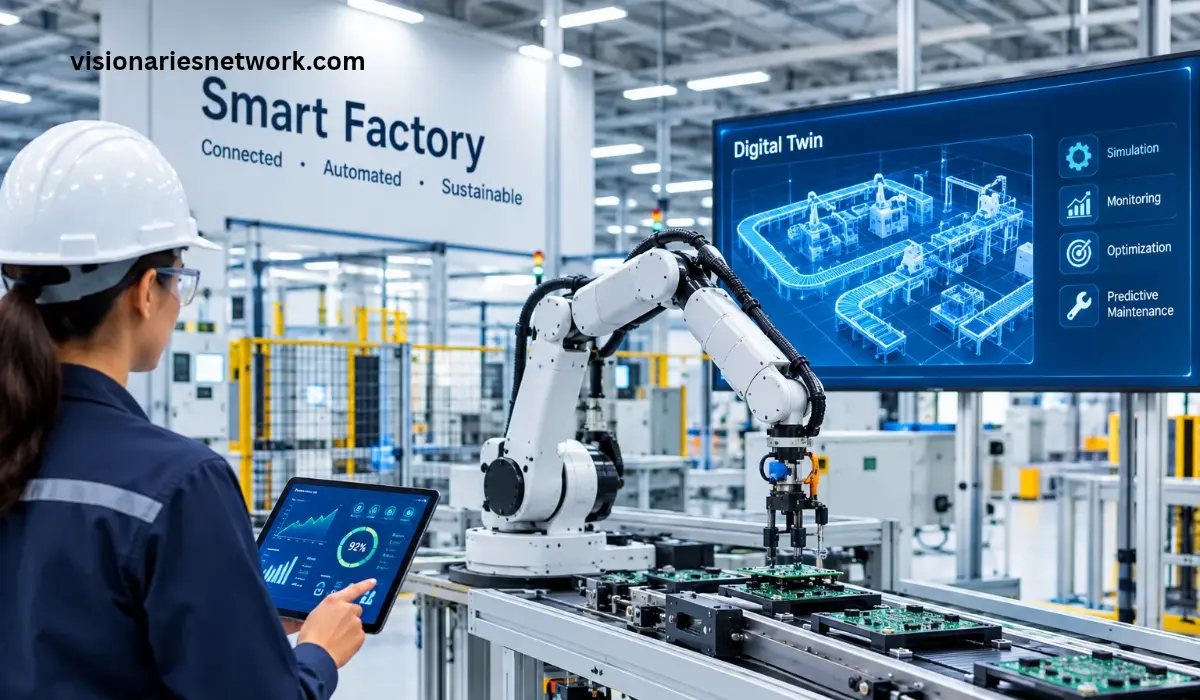
Factories have been automated for decades, but the latest shift is different. Machines are no longer being used only to repeat instructions faster. They are increasingly being connected to sensors, artificial intelligence, robotics, digital twins, and real-time data systems that allow production environments to respond to changing conditions. This is giving smart factories a more active role in how products are designed, made, inspected, and moved.
The change is already visible in manufacturing facilities operated by companies such as Siemens, Foxconn and BMW. At the same time, new facilities are being created specifically to test how far autonomous production can go. The idea of a factory that can monitor itself, identify problems and adjust operations with limited human intervention is moving beyond demonstrations and into practical industrial applications.
Siemens Is Showing What a Highly Automated Factory Can Already Do
One of the clearest examples comes from Siemens Electronics Works Amberg in Germany. The facility produces SIMATIC products and has been using digital technologies across its production processes for years. Siemens says around 17 million SIMATIC products are produced there annually, with roughly 1,000 product variants and about 50 million items of process and product data evaluated for production optimization.
The factory is not simply a collection of robots working behind closed doors. Data from machines and production processes is used to improve decisions on the factory floor. Siemens has also introduced AI-based inspection and predictive maintenance applications at Amberg.
In one example, an AI model analyzes process data related to soldered connections on circuit boards and predicts whether a board requires an additional X-ray inspection. That creates a closed-loop process in which information from production can influence what happens next. Siemens has also used digital twin simulations to examine production bottlenecks before changing physical equipment.
The significance is not that humans have disappeared from the factory. Instead, software and machines are taking on more of the monitoring and decision-support work that previously depended on manual inspection.
Foxconn Is Building a Digital Copy Before Changing the Real Factory
Foxconn provides another example of where digital manufacturing is heading. Through its Fii Omniverse Digital Twin platform, the company creates detailed virtual versions of production facilities. These digital environments can be used to test factory layouts, simulate robot movements, examine logistics and monitor production information.
According to NVIDIA’s Foxconn case study, the company uses digital twins to design and manage high-volume facilities, including those producing NVIDIA GB200 Grace Blackwell Superchip systems. Production lines can be virtually assembled before physical deployment, while robots and automated guided vehicles can be tested in simulation.
Foxconn says its digital twin approach can help cut factory planning and setup time, while NVIDIA reports that some thermal simulations that previously required hours can now be completed in minutes using AI-based models.
This matters because autonomous production requires more than individual machines that can operate independently. A factory also needs to understand how machines, people, materials, software and physical space interact. Digital twins provide a way to test those interactions before making expensive physical changes.
BMW Is Combining AI with Robotics and Virtual Factories
The automotive industry is also moving in this direction. BMW has developed its iFACTORY production strategy around automation, data and digital planning. The company says it has created digital twins for more than 30 plants, bringing together building information, logistics, systems and other production data.
BMW's AIQX platform analyzes sensor and image data from production lines to identify quality problems in real time. The company is also working with humanoid robots for complex assembly tasks and using smart transport systems to improve movement inside its factories.
This illustrates an important point about autonomous production. The technology is not limited to one breakthrough machine. Instead, several technologies are being connected so that inspection, transportation, production planning and assembly can work as parts of the same system.
India Is Testing the Lights-Out Factory Model
The movement is also reaching India. In September 2026, Tata Consultancy Services launched its Industrial Autonomy & Engineering Lab, Lights-Out Factory, at its Sahyadri Park campus in Pune. TCS describes it as India's first lights-out factory lab, designed to demonstrate how AI, robotics, digital twins, factory control systems and real-time operational intelligence can work together.
The facility includes a robotic battery-pack assembly line. Its purpose is not simply to show robots performing individual tasks, but to demonstrate a self-optimising production environment in which multiple technologies work together.
The development comes at a time when Indian manufacturing is receiving greater attention for its use of advanced technologies. A recent NITI Aayog roadmap identified AI and machine learning, digital twins and robotics among the technologies that could have a significant impact across priority manufacturing sectors.
The Autonomous Factory Still Needs People
Despite the rapid progress, the fully independent factory remains a work in progress. Manufacturing environments contain enormous amounts of data, equipment from different generations, safety requirements and processes that cannot always be easily standardized. NIST's 2026 roadmap on AI and machine learning for smart manufacturing points to challenges involving industrial data, integration with different sensing and control systems, and the need for trustworthy and explainable AI.
That is why the near-term picture is more likely to be factories where humans and autonomous systems work together than completely unmanned production floors.
The direction, however, is becoming clearer. Siemens is using AI and edge computing to make production decisions faster. Foxconn is using digital twins to simulate factories before deploying changes. BMW is connecting AI, robotics and virtual production environments, while TCS is testing a lights-out model in India.
These examples suggest that the next phase of manufacturing will not be defined by automation alone. Smart factories are becoming environments that can sense what is happening, understand production data, simulate possible outcomes and respond to changing conditions. As these capabilities mature, the factory of the future is beginning to look less like a distant concept and more like an industrial model already taking shape.
FAQs
1. What is an autonomous factory?
An autonomous factory uses connected machines, software, robotics, sensors, and AI to monitor and manage parts of production with limited human intervention. People still oversee operations, but many routine decisions can be handled by automated systems.
2. How are smart factories different from traditional automated factories?
Traditional automation usually performs specific tasks according to fixed instructions. Smart factories can collect and analyze production data, identify changes or problems, and adjust certain processes based on what the data shows.
3. What role does AI play in autonomous factories?
AI can help factories inspect products, identify unusual machine behavior, predict maintenance needs, optimize production processes, and make sense of large amounts of operational data.
4. Why are digital twins useful in manufacturing?
A digital twin creates a virtual representation of a physical factory, production line, or machine. Manufacturers can use it to test layouts, production changes, equipment movements, and other scenarios before making changes on the actual factory floor.
5. Will autonomous factories replace human workers?
Not necessarily. Current examples show that automation is mainly taking over repetitive, data-heavy, or highly controlled tasks. Human workers continue to handle supervision, maintenance, problem-solving, safety, engineering, and decisions that require judgment.
About the Company
Visionaries Network is a business media and PR platform that helps companies, leaders, and innovators build visibility, credibility, and growth.
Browse our most recent publications