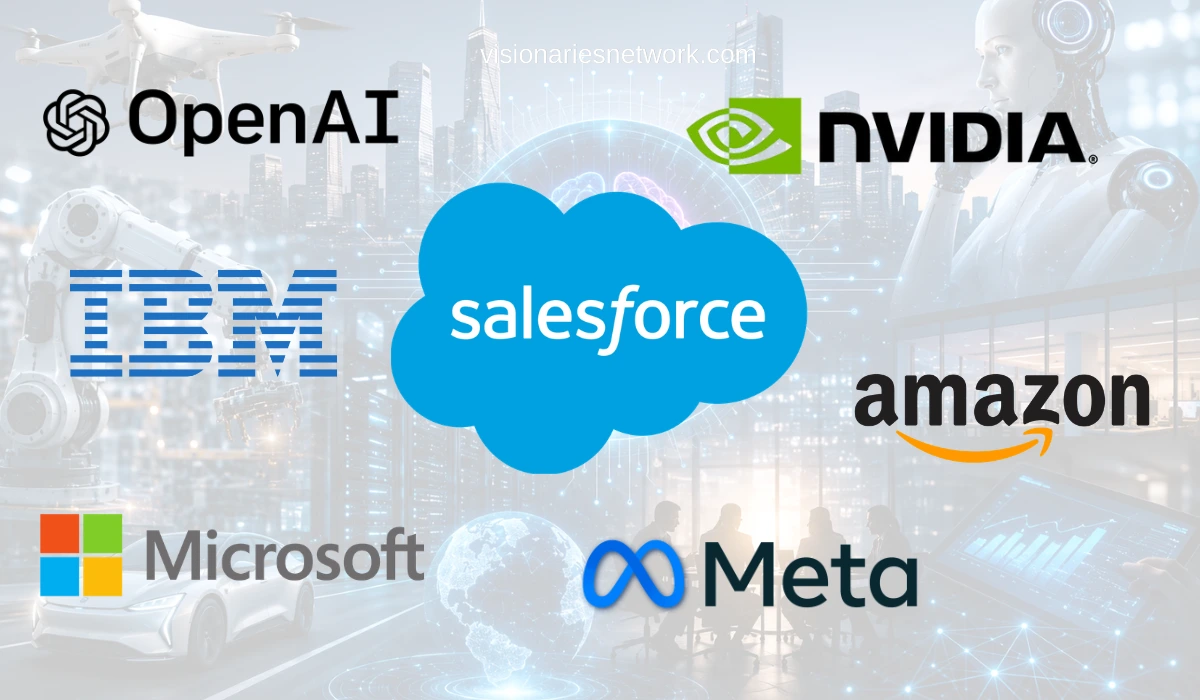
Top 10 AI Companies of 2026 Listed by Visionaries Network
Latest Updates





visionaries Network Team
31 July, 2026
ai vr and automation
Artificial intelligence is reshaping the global economy at an unprecedented pace. Today, AI companies are helping organizations automate operations, improve customer experiences, accelerate scientific research, strengthen cybersecurity, and unlock new business opportunities.
What was once considered an emerging technology has evolved into a strategic business asset, influencing nearly every industry from healthcare and finance to manufacturing, retail, transportation, and education.
Businesses that successfully integrate AI into their operations are improving productivity, reducing costs, and making faster, data-driven decisions while creating innovative products and services that were unimaginable only a few years ago.
The rapid adoption of AI is supported by advances in cloud computing, high-performance processors, and increasingly sophisticated machine learning models. Organizations no longer need to build complex AI infrastructure from scratch because cloud platforms now provide scalable computing resources, pre-trained models, and development tools that significantly reduce implementation time. This accessibility has enabled businesses of all sizes to experiment with artificial intelligence and deploy solutions that address real business challenges.
Another important factor behind AI's growth is the explosion of data generated through digital interactions. Every online purchase, financial transaction, medical record, sensor reading, and customer review contributes valuable information that intelligent algorithms can analyze.
Instead of relying solely on historical reporting, organizations now use AI to predict customer behavior, optimize supply chains, identify security threats, improve operational efficiency, and support strategic decision-making.
Generative AI has further accelerated this transformation by allowing businesses to automate knowledge-intensive work. Marketing teams generate campaign ideas faster, software developers receive coding assistance, legal professionals review lengthy contracts more efficiently, and healthcare providers reduce administrative workloads through intelligent documentation systems. These capabilities enable employees to spend more time solving complex problems while AI handles repetitive and time-consuming tasks.
Investment in artificial intelligence continues to grow as organizations recognize that AI is becoming essential for long-term competitiveness. According to the IDC Worldwide AI Spending Guide, worldwide spending on AI is expected to exceed $630 billion by 2028, while PwC estimates artificial intelligence could contribute $15.7 trillion to the global economy by 2030. These projections highlight how AI is transitioning from experimental technology into a core component of business strategy.
Although thousands of technology vendors now offer AI-powered products, only a relatively small number consistently shape the industry's direction. These organizations invest billions of dollars in research, semiconductor development, cloud infrastructure, enterprise software, robotics, and advanced language models. Their innovations not only power their own products but also enable countless other businesses to build intelligent applications more efficiently.
The companies highlighted in the Top 10 AI Companies of 2026 have demonstrated exceptional leadership by combining technological innovation with practical business applications. Their influence extends beyond software development to include cloud computing, autonomous systems, scientific research, enterprise productivity, and intelligent automation, making them key drivers of the global AI ecosystem.
1. NVIDIA
NVIDIA has become the backbone of modern artificial intelligence by providing the high-performance GPUs that power many of today's advanced AI models. Originally recognized for graphics processing technology, the company has expanded into AI computing, networking, robotics, and digital twin technologies.
Its CUDA platform, DGX systems, and AI software libraries provide developers and researchers with the tools required to train and deploy increasingly sophisticated machine learning models.
Real Example
Major cloud providers including Microsoft Azure, Google Cloud, Oracle Cloud, and Amazon Web Services rely on NVIDIA hardware to support large-scale AI training and enterprise AI services.
2. Microsoft
Microsoft has successfully integrated artificial intelligence throughout its software ecosystem. Rather than treating AI as a separate product, the company embeds intelligent capabilities into Microsoft 365, Azure AI, GitHub Copilot, Dynamics 365, and Windows.
This strategy enables businesses to automate repetitive tasks, summarize meetings, generate reports, write software code, and analyze business information using applications employees already use every day.
Real Example
Financial institutions use Microsoft Azure AI to automate loan processing, strengthen fraud detection, improve compliance monitoring, and deliver intelligent customer support.
3. Google
Google continues to lead AI innovation through its extensive investments in machine learning research, cloud computing, natural language processing, and computer vision. Its Gemini models support Google Search, Workspace, Android, and Google Cloud while helping developers build intelligent applications for businesses across multiple industries.
Real Example
Google DeepMind's AlphaFold has predicted the structures of hundreds of millions of proteins, significantly accelerating biological research and pharmaceutical discovery worldwide.
4. OpenAI
OpenAI transformed artificial intelligence from a specialist technology into a mainstream business tool through ChatGPT and the GPT family of language models. Organizations use its technology to generate content, analyze documents, develop software, automate customer support, and improve workplace productivity.
Real Example
Thousands of organizations integrate OpenAI's APIs into enterprise software, allowing employees to automate repetitive tasks and improve decision-making through conversational AI.
5. Amazon
Amazon combines one of the world's largest cloud computing platforms with advanced AI capabilities through Amazon Web Services. Services such as Bedrock and SageMaker allow businesses to build, customize, and deploy AI applications while benefiting from secure, scalable infrastructure.
Internally, Amazon applies artificial intelligence throughout warehouse automation, recommendation engines, logistics planning, demand forecasting, fraud prevention, and inventory management.
Real Example
Retailers use Amazon AI services to optimize inventory levels, personalize customer recommendations, forecast seasonal demand, and improve supply chain efficiency across global markets.
6. Meta
Meta has placed artificial intelligence at the center of its long-term growth strategy. Beyond enhancing content recommendations across Facebook and Instagram, the company is investing in open-source AI models, immersive digital experiences, and next-generation computing platforms. Its Llama family of large language models has become one of the most widely adopted open AI model families, allowing developers and businesses to build customized applications while reducing development costs.
Real Example
Meta AI is integrated into WhatsApp, Facebook, Instagram, and Messenger, enabling users to search for information, generate images, summarize content, and receive conversational assistance directly within the apps they already use.
7. Anthropic
Anthropic has established itself as a leader in enterprise artificial intelligence by focusing on reliability, transparency, and responsible AI development. Its Claude models assist organizations with document analysis, software development, business research, and knowledge management while maintaining strong safeguards against inaccurate or unsafe outputs.
Real Example
Legal firms, consulting companies, and financial organizations use Claude to summarize lengthy documents, compare contracts, identify critical clauses, and accelerate research without compromising data privacy.
8. IBM
IBM continues to demonstrate how artificial intelligence can solve complex enterprise challenges. Through its watsonx platform, organizations can develop, deploy, and govern AI applications while maintaining compliance, explainability, and security.
IBM's solutions are widely adopted across healthcare, banking, insurance, telecommunications, and government sectors where transparency and regulatory requirements are essential.
Real Example
Healthcare providers use IBM AI to analyze patient records, streamline clinical documentation, improve hospital operations, and support physicians with evidence-based decision-making.
9. Salesforce
Salesforce has integrated artificial intelligence into customer relationship management by embedding Einstein AI throughout its platform. Businesses use these capabilities to automate sales processes, personalize customer interactions, forecast revenue, and improve marketing performance.
Real Example
Retail brands use Salesforce AI to predict customer purchasing behavior, recommend products, automate marketing campaigns, and identify customers at risk of leaving.
10. Tesla
Tesla demonstrates how artificial intelligence extends beyond software into real-world machines. Its AI technologies power autonomous driving, advanced manufacturing, robotics, and computer vision systems capable of interpreting complex driving environments.
The company's investments in autonomous systems and the Optimus humanoid robot illustrate how AI will increasingly influence manufacturing, logistics, and industrial automation.
Real Example
Tesla continuously improves its Full Self-Driving software using billions of miles of real-world driving data collected from vehicles operating across diverse environments.
The Growing Influence of Industry Leaders
The organizations featured in the Top 10 AI Companies of 2026 represent different segments of the artificial intelligence ecosystem, yet they share a common characteristic: they transform cutting-edge research into practical business solutions.
Some specialize in high-performance computing, others focus on enterprise software or cloud infrastructure, while several concentrate on scientific research, customer engagement, or autonomous systems. Collectively, they are accelerating AI adoption across industries and helping organizations solve increasingly complex business challenges.
AI by the Numbers
Artificial intelligence continues to expand at an extraordinary pace.
These figures indicate that AI has become a long-term strategic investment rather than a short-term technology trend.
For a broader perspective on global AI adoption, investment, and research trends, the Stanford AI Index Report 2024 provides one of the most comprehensive annual analyses of the artificial intelligence landscape.
Industry-Specific Use Cases
1. Healthcare
Hospitals use AI to analyze medical images, accelerate disease diagnosis, support drug discovery, automate clinical documentation, and improve patient monitoring.
2. Financial Services
Banks apply AI to fraud detection, anti-money laundering, investment analysis, credit scoring, and customer support automation.
3. Manufacturing
Manufacturers use AI-powered predictive maintenance, robotics, production scheduling, quality inspection, and supply chain optimization to improve operational efficiency.
4. Retail and E-commerce
Retail organizations leverage AI for demand forecasting, inventory optimization, personalized recommendations, dynamic pricing, and customer engagement.
5. Transportation and Logistics
AI enables intelligent route optimization, warehouse automation, predictive maintenance, fleet management, and autonomous vehicle development.
6. Cybersecurity
Organizations increasingly rely on AI to detect cyber threats, identify abnormal network behavior, prioritize security incidents, and automate responses before attacks spread.
7. Education
Educational institutions use AI for intelligent tutoring, automated grading, personalized learning experiences, curriculum planning, and student performance analysis.
Looking Ahead
Artificial intelligence is entering a phase where long-term success depends on practical implementation rather than technological novelty alone. Businesses increasingly seek AI platforms that are secure, scalable, explainable, and capable of integrating seamlessly into existing workflows. Organizations that combine advanced technology with responsible governance and measurable business outcomes will continue leading the next wave of digital transformation.
As adoption expands across every major industry, artificial intelligence will increasingly support strategic decision-making, operational efficiency, scientific research, and customer innovation. The organizations highlighted in this article have established strong foundations for future growth through continuous investment in research, infrastructure, and enterprise solutions.
Conclusion
Artificial intelligence is reshaping how businesses innovate, compete, and create value across the global economy. From powering advanced cloud infrastructure and enterprise software to accelerating healthcare research and autonomous technologies, intelligent systems are becoming essential to long-term business success.
The AI companies featured throughout this article demonstrate that lasting leadership requires more than developing sophisticated algorithms. It depends on continuous research, scalable infrastructure, responsible innovation, and practical solutions that address real-world challenges. As businesses continue investing in intelligent technologies, these organizations will remain at the forefront of shaping a smarter, more connected, and increasingly automated future.
FAQs
1. Which AI companies are leading innovation in 2026?
Leading AI innovators in 2026 include NVIDIA, Microsoft, Google, OpenAI, Amazon, Meta, Anthropic, IBM, Salesforce, and Tesla. These companies are advancing artificial intelligence through cloud computing, enterprise software, generative AI, robotics, autonomous systems, and semiconductor technologies.
2. Why are AI companies becoming so important across industries?
AI companies provide technologies that help businesses automate repetitive tasks, improve decision-making, enhance customer experiences, strengthen cybersecurity, and optimize operations. Their solutions enable organizations to increase efficiency while driving innovation and long-term growth.
3. Which industries benefit the most from artificial intelligence?
Artificial intelligence is widely used in healthcare, financial services, manufacturing, retail, transportation, cybersecurity, and education. Organizations in these sectors use AI for applications such as predictive analytics, fraud detection, personalized recommendations, intelligent automation, and operational optimization.
4. What factors make an AI company an industry leader?
Industry-leading AI companies invest heavily in research and development, advanced computing infrastructure, cloud platforms, responsible AI practices, and scalable enterprise solutions. Their ability to deliver practical business value while continuously innovating sets them apart from competitors.
5. How is artificial intelligence expected to evolve in the coming years?
Artificial intelligence is expected to become more integrated into everyday business operations through smarter automation, improved generative AI models, autonomous systems, and industry-specific applications. Organizations will increasingly focus on responsible AI, data security, and measurable business outcomes as adoption continues to grow.
Visionaries Network recognizes outstanding leaders, innovative companies, and forward-thinking organizations that are driving meaningful progress across industries. Through executive features, industry rankings, and business insights, the platform highlights leadership excellence, innovation, and business success while connecting readers with the people and companies shaping the future.
Browse our most recent publications