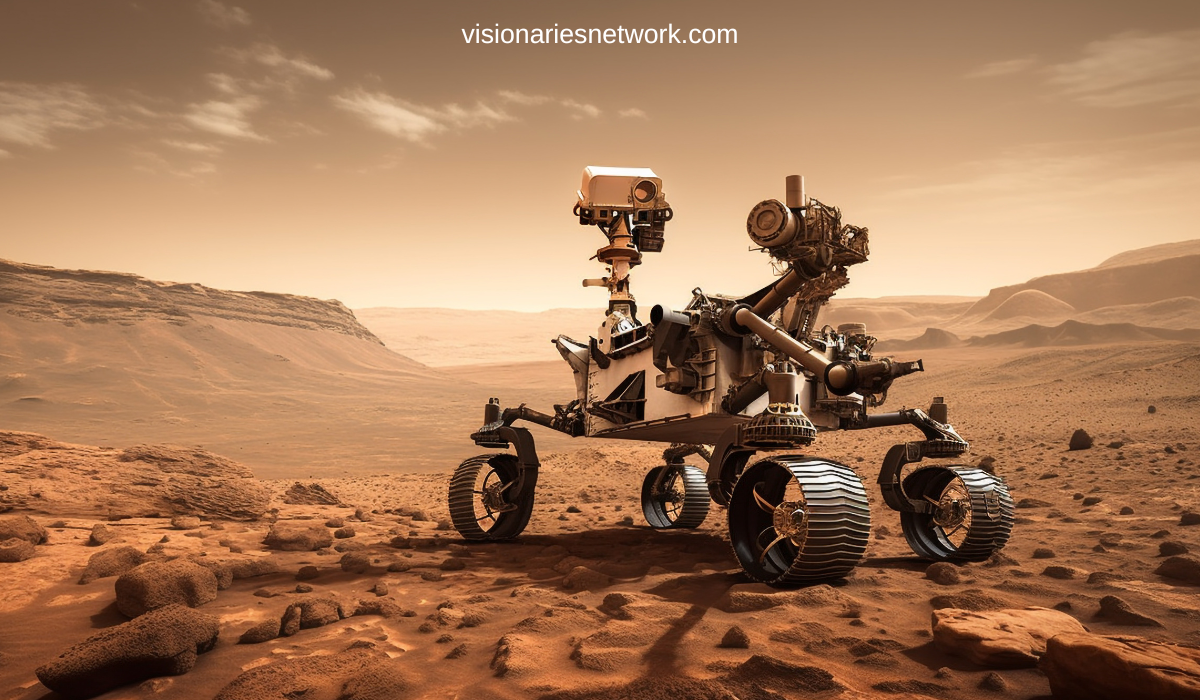
Space Robotics Gets Boost with DLR Test Site
Latest Updates






visionaries Network Team
02 July, 2026
iot and robotics
DLR launches a new Moon-Mars Test Site to advance space robotics, helping researchers develop autonomous systems for future lunar and Martian missions
The German Aerospace Center (DLR) has inaugurated its new Moon-Mars Test Site at the Robotics and Mechatronics Center (RMC) in Oberpfaffenhofen, Germany, providing researchers with a realistic environment to develop and evaluate robotic technologies for future lunar and Martian missions.
The new facility represents a significant milestone for the space robotics industry as global space agencies continue investing in autonomous systems capable of operating in extreme extraterrestrial environments.
A New Hub for Planetary Robotics
Spread across 1,500 square metres, the Moon-Mars Test Site replicates the geological conditions of both the Moon and Mars using basalt, lava rock, fine gravel, craters, dunes, tunnels, and rugged terrain. The facility enables scientists to test wheeled and legged robots, autonomous navigation systems, robotic arms, and mobile manipulation technologies under realistic conditions without traveling to remote testing locations such as Mount Etna.
The growing demand for robotic exploration reflects increasing global investment in space technologies. According to the Space Robotics Market report by Fortune Business Insights, the sector is expected to expand steadily as governments and private companies accelerate lunar and Mars exploration programs.
Supporting Future Moon and Mars Missions
DLR said the test site will support research into autonomous mobility, object recognition, multi-robot collaboration, and robotic manipulation while generating standardized datasets for research institutions and industry partners. The facility will also contribute to projects such as the German-French IDEFIX rover, which is scheduled to explore Phobos during Japan's Martian Moons eXploration (MMX) mission.
By providing continuous access to realistic planetary terrain, researchers can rapidly refine robotic systems and reduce the time required to validate new technologies before they are deployed on future missions.
As international interest in space robotics continues to grow, DLR's Moon-Mars Test Site is expected to strengthen Europe's role in planetary exploration while helping develop the next generation of autonomous robots capable of operating in some of the harshest environments beyond Earth.
FAQs
1. What is the DLR Moon-Mars Test Site?
The DLR Moon-Mars Test Site is a new research facility in Oberpfaffenhofen, Germany, designed to simulate the terrain and environmental conditions of the Moon and Mars for testing advanced robotic systems.
2. Why did DLR build the Moon-Mars Test Site?
The facility was created to help researchers develop and validate autonomous robots that can explore planetary surfaces, conduct scientific missions, and prepare infrastructure before astronauts arrive.
3. What technologies will be tested at the new facility?
Researchers will test autonomous navigation systems, wheeled and legged robots, robotic manipulators, object recognition technologies, and multi-robot collaboration in realistic extraterrestrial environments.
4. How will the Moon-Mars Test Site support future space missions?
The test site allows engineers to refine robotic systems for upcoming lunar and Martian missions, including projects like the IDEFIX rover, by providing a controlled environment that closely resembles planetary terrain.
5. Why is space robotics becoming increasingly important?
Space robotics enables autonomous exploration of hazardous environments, supports scientific research, assists in resource utilization, and prepares landing sites, making it a critical technology for future Moon and Mars exploration missions.
Browse our most recent publications