NVIDIA DLSS 5 Marks a Breakthrough in Real-Time Graphics
Latest Updates





visionaries Network Team
17 March, 2026
ai vr and automation
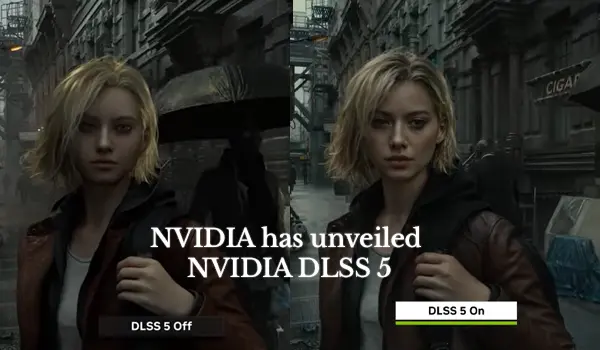
NVIDIA has unveiled NVIDIA DLSS 5, calling it the biggest leap in computer graphics since real-time ray tracing first emerged in 2018. The new technology introduces a real-time neural rendering model that significantly enhances visual realism, bringing gaming graphics closer than ever to Hollywood-quality visual effects.
According to Jensen Huang, the innovation represents a turning point for the industry. He described NVIDIA DLSS 5 as the “GPT moment for graphics,” highlighting its ability to combine traditional rendering techniques with generative AI to produce highly realistic visuals without sacrificing artistic control.
Bridging the Gap Between Games and Hollywood
For decades, NVIDIA has pushed the boundaries of graphics technology—from programmable shaders in the early 2000s to CUDA architecture and real-time ray tracing. Despite these advancements, a major gap has persisted between real-time game rendering and cinematic visual effects, which often take hours per frame to produce.
NVIDIA DLSS 5 aims to close that gap. Instead of relying solely on brute computing power, the system uses AI to interpret and enhance each frame. By processing color and motion data, it adds photorealistic lighting, textures, and materials in real time, even at 4K resolution.
This marks a shift from DLSS’s original role as a performance booster. While earlier versions focused on upscaling and frame generation, NVIDIA DLSS 5 transforms the actual visual fidelity of scenes, making them more lifelike and immersive.
How Neural Rendering Changes the Game
At the core of NVIDIA DLSS 5 is a deep learning model trained to understand complex visual elements such as skin, hair, fabric, and environmental lighting. The system ensures that enhancements remain consistent across frames—an essential requirement for gaming.
Unlike traditional video AI models, which often produce unpredictable results, DLSS 5 maintains determinism. This means developers can rely on stable, repeatable outputs that align with the game’s artistic direction.
The technology also introduces fine-grained controls, allowing developers to adjust intensity, color grading, and masking. This ensures that while realism improves, each game retains its unique visual identity.
Strong Industry Support and Game Integration
Major game developers have already embraced NVIDIA DLSS 5. Companies like Bethesda, CAPCOM, Ubisoft, and Tencent are integrating the technology into upcoming titles.
Early demonstrations in games like Starfield and Assassin’s Creed Shadows have shown significant improvements in lighting realism and environmental detail. Developers say the technology allows them to build more immersive worlds without dramatically increasing production time.
A New Chapter for Gaming Graphics
With support already planned for major upcoming titles, NVIDIA DLSS 5 is poised to redefine industry standards. By merging AI with traditional rendering pipelines, it delivers a level of realism previously thought unattainable in real-time environments.
As the gaming industry continues to evolve, NVIDIA DLSS 5 could become the foundation for the next generation of visual experiences—where the line between virtual and real becomes increasingly blurred.
Browse our most recent publications